

5 Ways Tier 1 Spend Analytics Reduces Manual Work and Improves Accuracy
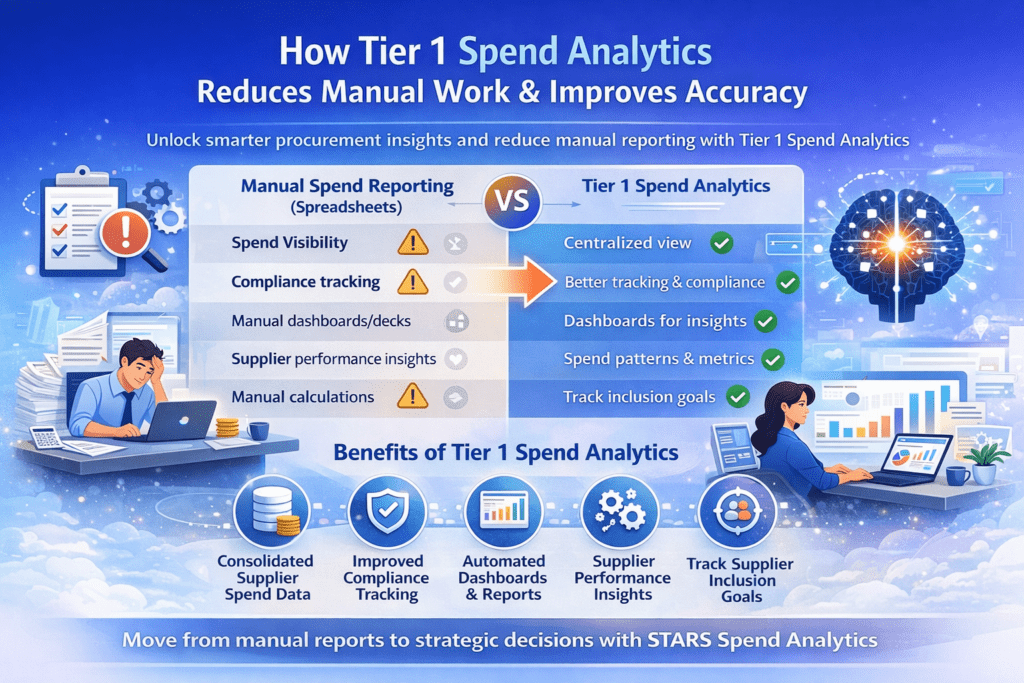
Manual spend reporting creates bottlenecks across procurement, finance, and supplier diversity teams. The fix is not “more spreadsheets,” but cleaner data and faster insights. Tier 1 spend analytics reduces manual work by automating data capture, improving classification, and producing consistent reporting. In this blog, we break down 5 ways modern spend analytics software and spend data analytics workflows increase speed and accuracy for enterprise teams.
Tier 1 spend analytics reduces manual work by automating supplier spend visibility, improving compliance tracking, and generating actionable insights from direct supplier data. It improves accuracy by using up-to-date supplier records, structured reporting fields, and dashboards that support procurement decisions without repetitive cleanup. The result is less time reconciling data and more time optimizing spend.
Recent Spend Analytics Statistics
Here are few recent stats showing why organizations are investing in cleaner analytics and reducing manual reporting:
- According to Forbes, Oct 22, 2025, poor data quality costs organizations an average of $12.9 million per year.
- According to Axios, Jul 30, 2024, the average cost of a data breach reached $4.88 million per incident (measured March 2023 to Feb 2024).
- According to Deloitte’s 2023 Global Chief Procurement Officer Survey, the report includes insights from nearly 350 procurement leaders across 40+ countries, reflecting rising pressure on procurement teams to deliver value with limited resources.
- According to Mordor Intelligence (published 2025), the global spend analytics market is projected to expand through 2030, showing increased investment in spend visibility and automation.
Quick Facts: Tier 1 Spend Analytics Benefits
- Automates visibility into direct supplier spend
- Supports better tracking, compliance, and procurement decision-making
- Connects to ERP/AP systems to streamline import and export
- Provides supplier performance insights and spend patterns
- Reduces reporting effort with dashboards and structured metrics
STARS summarizes Tier 1 Spend Analytics as a way to gain direct supplier spend insights that improve tracking, compliance, and decision-making.
What Is Tier 1 Spend Analytics?
Tier 1 spend analytics is the process of analyzing direct supplier spend using data from your internal ERP and accounts payable systems to uncover spend patterns, track supplier performance, and strengthen compliance reporting. It helps organizations make data-driven decisions using dashboards and spend insights tied to Tier 1 suppliers.
1. Tier 1 Spend Analytics Improves Spend Visibility Without Manual Consolidation
Tier 1 spend analytics reduces manual work by consolidating direct supplier spend data into one consistent view. Instead of manually combining reports from ERP systems, AP exports, and business unit spreadsheets, teams gain centralized visibility into spend patterns and supplier performance. That reduces reconciliation time and improves accuracy across dashboards and reporting.
What STARS highlights as the value of Tier 1 spend insights
STARS explains that Tier 1 Spend Analytics gives organizations direct supplier spend insights that support data-driven decisions, improved tracking, and compliance.
Why visibility eliminates manual work
Without strong spend visibility, teams waste time doing tasks like:
- downloading reports across systems
- combining multiple versions of supplier spend
- manually searching for “what changed” month to month
- validating totals before leadership reviews
With Tier 1 spend analytics, your time shifts from rebuilding reports to acting on insights.
2. Tier 1 Spend Analytics Supports Compliance Tracking With Cleaner, Consistent Data
Tier 1 spend analytics improves accuracy by structuring spend data so organizations can track compliance reliably. When supplier data is up to date and standardized, it becomes easier to monitor regulatory requirements, confirm supplier status, and validate reporting metrics. This reduces manual back-and-forth and prevents errors caused by inconsistent supplier records.
How STARS frames the compliance impact
STARS emphasizes that Tier 1 Spend Analytics supports improved tracking and regulatory compliance using insights into direct supplier spend.
Where manual compliance reporting breaks down
Most errors happen when teams rely on:
- inconsistent supplier master data
- unverified certification fields
- mismatched supplier names across departments
- repeated “one-off cleanup” before reporting deadlines
Tier 1 spend analytics reduces that cleanup by keeping reporting inputs cleaner in the first place.
3. Tier 1 Spend Analytics Automates Reporting With Dashboards Instead of Spreadsheets
Tier 1 spend analytics reduces manual reporting work by replacing spreadsheet-based reporting with dashboards and repeatable KPI views. Instead of formatting charts and rebuilding monthly decks, procurement teams can track spend, performance, compliance, and risk using centralized Tier 1 analytics dashboards that refresh more consistently and reduce reporting errors.
What STARS says about Tier 1 analytics dashboards
STARS highlights that dashboards combining spend, supplier performance, contract usage, risk, and process efficiency create stronger procurement intelligence.
Why dashboards reduce manual work
Dashboards remove time spent on:
- exporting data every week
- rebuilding the same pivot tables
- correcting small chart inconsistencies
- answering repeat stakeholder questions
Instead, stakeholders can self-serve insights directly from reporting views.
4. Tier 1 Spend Analytics Helps Teams Track Supplier Performance Without Extra Manual Analysis
Tier 1 spend analytics improves accuracy by linking spend patterns to supplier performance insights. Rather than relying on manual scorecards or scattered KPIs, teams can analyze supplier outcomes and identify opportunities for improvement and investment. This reduces manual follow-ups and enables faster, more objective supplier management decisions.
STARS view: spend patterns + supplier performance insights
STARS lists key reasons to implement Tier 1 Spend Analytics, including analyzing spend patterns and supplier performance, and identifying opportunities for additional investments.
Practical examples of performance insights procurement can extract
With strong spend data analytics, teams can spot:
- suppliers with high spend but low performance
- performance issues tied to certain regions or divisions
- overdependence on a small supplier group
- categories where quality issues are increasing spend
This moves supplier management from reactive to measurable.
5. Tier 1 Spend Analytics Tracks Progress Toward Supplier Inclusion Goals More Accurately
Tier 1 spend analytics reduces manual work by automating progress tracking toward supplier inclusion goals. Instead of manually calculating diverse spend totals, validating certifications, and updating leadership summaries, teams can track spend outcomes through consistent Tier 1 analytics. This improves accuracy, shortens reporting cycles, and supports transparent goal measurement.
STARS focus: tracking supplier inclusion progress
STARS explicitly highlights tracking progress toward supplier inclusion goals as a reason to use Tier 1 Spend Analytics.
Why this reduces manual work
Supplier inclusion reporting often requires:
- manual validation of supplier classifications
- pulling data from multiple sources
- adjusting “what counts” definitions each cycle
- frequent revisions before stakeholders sign off
Tier 1 spend analytics helps standardize this process so reports are repeatable.
Comparison Table: Tier 1 Spend Analytics vs Manual Spend Reporting
| Area | Manual Reporting (Spreadsheets) | Tier 1 Spend Analytics |
|---|---|---|
| Spend Visibility | Fragmented across exports | Centralized Tier 1 view |
| Compliance Tracking | High cleanup effort | Better tracking and compliance |
| Reporting | Manual dashboards and decks | Dashboards for procurement intelligence |
| Supplier Performance Insights | Hard to connect to spend | Spend patterns + performance insights |
| Supplier Inclusion Progress | Manual calculations | Track inclusion goals consistently |
Key Takeaways
- Tier 1 spend analytics consolidates direct spend data, reducing manual consolidation
- Better tracking and compliance reduce reporting errors and last-minute cleanup
- Dashboards reduce repetitive reporting tasks and improve stakeholder access
- Supplier performance insights become easier to measure and act on
- Supplier inclusion goal tracking becomes faster and more accurate
Conclusion: Tier 1 Spend Analytics Turns Manual Reporting Into Strategic Decision-Making
If your team is still trapped in spreadsheet-based spend reporting, you are spending too much time validating data instead of improving procurement outcomes. Tier 1 spend analytics reduces manual work by consolidating spend visibility, strengthening compliance reporting, enabling dashboards, and creating a structured approach to supplier insights.
Want to cut reporting time and improve the accuracy of your Tier 1 supplier data? Contact STARS to see how Tier 1 spend analytics can streamline spend reporting, strengthen supplier insights, and support smarter procurement decisions.

Marketing professional passionate about people, creativity, and meaningful growth. Proud to be part of the STARS team, empowering businesses to discover and manage diverse suppliers through one powerful platform.