
Global Supplier Registration: Challenges and Solutions
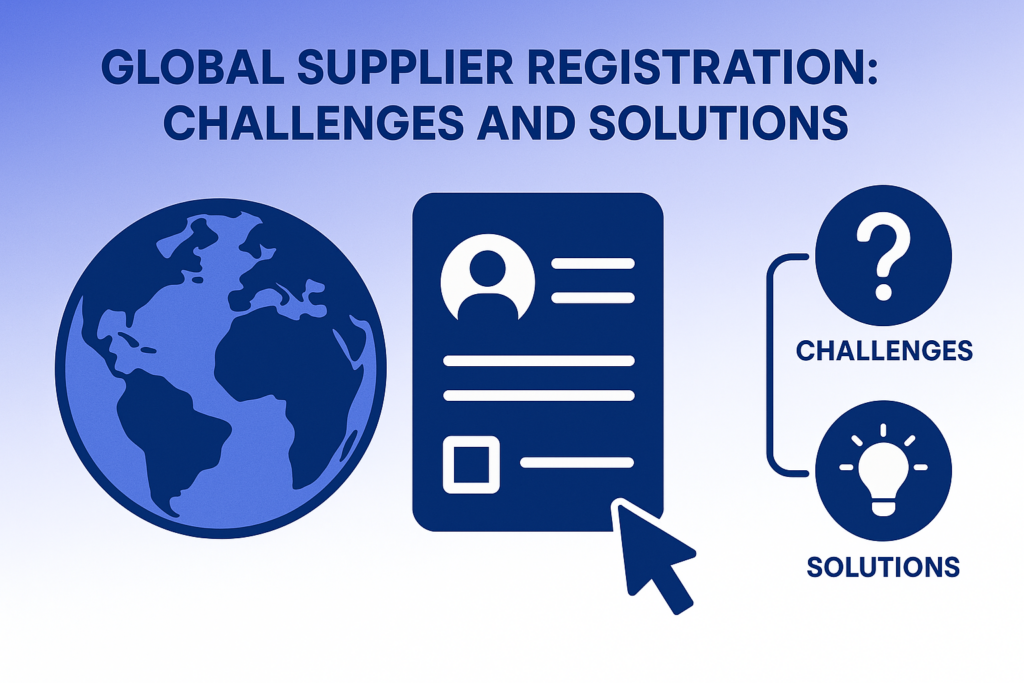
Global supplier registration helps companies collect, verify, and approve vendor information in a structured and compliant manner. This process ensures supply chain transparency, protects against risk, and supports efficient procurement. Yet many organizations struggle with delays, low data quality, and global compliance complexities. This guide explains the most common supplier registration challenges and offers practical, strategic solutions that help businesses streamline onboarding at scale.
Why Supplier Registration Matters
Supplier registration, often referred to as supplier onboarding, is the process of gathering, validating, and approving a supplier’s business information before procurement activities begin. It involves financial checks, compliance documentation, vendor identification, ESG insights, cybersecurity standards, and overall business capability assessments.
The importance of this process continues to grow as global supply chains expand. Strong supplier registration ensures:
- Compliance with legal, regulatory, and environmental standards
- Accurate supplier documentation for audits and risk assessments
- Faster and more efficient procurement cycles
- Higher supplier reliability and reduced exposure to fraud or disruption
Supplier registration is not just a procedural task. It is a strategic step that helps companies build resilient supplier ecosystems.
Global Supplier Registration Challenges
1. Time-consuming and manual processes
Many organizations still depend on manual tools such as email attachments, spreadsheets, and scattered documents. This slows down verification and increases the likelihood of errors. According to Harvard Business Review in 2023, onboarding new suppliers can take as long as six months for large enterprises.
Manual onboarding causes several issues:
- Excessive back and forth communication
- Delayed approval cycles that involve multiple departments
- Increased operational costs from repetitive work
- A high chance of document loss or inconsistent record keeping
In long supply chains, these delays create bottlenecks that slow down product launches, sourcing activities, and overall operational speed.
2. Data security and compliance risks
Supplier registration involves handling sensitive business data such as tax information, financial statements, cybersecurity documents, and identity records. Without structured processes, this data is vulnerable to misuse or exposure.
Companies that work across multiple regions also face varying compliance standards related to:
- Data privacy
- Anti-corruption laws
- Environmental compliance
- Labor standards
- Industry certifications
Global suppliers often follow different regulations, which makes consistency difficult. If compliance gaps remain undetected, the buying organization may face legal penalties, supply chain disruptions, or reputational harm.
3. Technical and system integration gaps
Not all suppliers have advanced digital capabilities. Many small or midsize suppliers use basic tools that do not connect easily with procurement or ERP systems. This creates challenges such as:
- Mismatched document formats
- Inconsistent or incomplete submissions
- Duplicate supplier records
- Difficulty merging supplier data into company systems
These integration challenges slow down approvals and prevent organizations from maintaining a complete and accurate supplier database.
4. Complex global compliance and due diligence demands
Due diligence is a necessary part of supplier registration, particularly for companies working in highly regulated industries or across international markets. Global due diligence involves:
- Reviewing business identity and financial stability
- Checking ESG and sustainability claims
- Verifying legal compliance by region
- Confirming certifications for manufacturing, quality, or safety standards
Despite the need for visibility, many supply chains remain opaque. Only sixty percent of companies have clear visibility into their tier one suppliers, according to a 2024 McKinsey survey.
This lack of visibility increases the risk of hidden disruptions and compliance exposure.
5. Poor data quality and incomplete supplier information
Supplier data issues are one of the most common challenges in onboarding. Suppliers may submit outdated, inaccurate, or incomplete documentation. This creates:
- Slow review cycles
- Repeated information requests
- Difficulty passing audit checks
- Higher operational risk
When supplier data is unreliable, procurement decisions suffer, and overall supply chain performance declines.
Key Statistics on Supplier Registration
- Supplier onboarding can take up to six months for large organizations.
- According to Veridon, Seventy-three percent of procurement leaders still use manual data processes.
- Only sixty percent of companies have visibility into tier one suppliers.
- Only six percent of companies have full end to end supply chain visibility.
These statistics highlight how fragmented and inefficient traditional supplier onboarding remains, even as supply chain risks rise.
Solutions to Improve Supplier Registration
1. Standardize and automate supplier onboarding
A centralized supplier portal gives suppliers a single location to submit documents, track progress, and update their information. This improves:
- Data consistency
- User experience for suppliers
- Review and approval workflows
- Availability of audit ready documentation
Automation eliminates repetitive manual work and allows procurement teams to focus on strategic activities.
2. Integrate onboarding with ERP and procurement systems
Integration with ERP or procurement systems ensures that supplier data flows automatically into purchasing, finance, and risk management modules. This creates a single source of truth and helps organizations maintain clean, accurate records.
Key benefits include:
- Faster supplier activation
- Reduced record duplication
- More accurate procurement analytics
- Better compliance tracking
Integration also supports scalability for organizations with global supplier networks.
3. Introduce early compliance and risk checks
Early risk evaluation helps filter out non compliant or high risk suppliers before they reach later stages of onboarding. This includes reviewing:
- Business licenses and tax documentation
- Security and data protection standards
- Financial stability indicators
- ESG and global labor compliance
Automation can handle periodic rechecks, ensuring long term compliance.
4. Treat suppliers as long termpartners
Supplier onboarding should be a collaborative process rather than a one sided administrative task. Companies that support and educate suppliers often see greater compliance, faster onboarding, and higher supplier satisfaction.
Effective partnership practices include:
- Clear communication about required documentation
- Simple and accessible onboarding instructions
- Support for suppliers that lack digital tools
- Training for technology, compliance, or platform requirements
When suppliers understand expectations early, the onboarding process becomes smoother and more efficient.
5. Improve supplier visibility and segmentation
Supplier registration should collect detailed supplier insights that help organizations strengthen their supply chain strategies. Useful data points include:
- Supplier diversity status
- Environmental and sustainability metrics
- Operating region and geopolitical risks
- Quality and performance history
Segmenting suppliers based on risk level, value contribution, or category helps companies allocate resources effectively and sustain stronger supplier relationships.
Key Takeaways
- Supplier onboarding is often slow due to manual, inconsistent processes.
- Data quality issues and compliance risks remain major obstacles.
- Visibility into global suppliers is still limited across most industries.
- Automation and integration help reduce onboarding time significantly.
- Early compliance checks prevent long term risks and disruptions.
Case Study Example
A global manufacturing company previously relied on email threads and spreadsheets to onboard new suppliers. Onboarding typically required nearly two months because legal, finance, procurement, and compliance teams needed multiple rounds of document reviews.
After implementing a centralized supplier portal integrated with its ERP system, the company achieved the following results:
- Onboarding time decreased from fifty days to fewer than seven
- Data errors were reduced by more than ninety percent
- Documents became immediately audit ready
- Supplier satisfaction improved due to clearer communication and faster approvals
This case illustrates how structured onboarding and automation support better compliance, stronger supplier relationships, and significantly faster procurement operations.
Conclusion
Supplier registration is a foundational step in building a resilient global supply chain. Although challenges such as manual processes, low data quality, and complex cross border compliance remain common, organizations can overcome these issues by adopting standardized workflows, automation, and integrated technology solutions.
If your organization needs support with supplier registration or supplier diversity programs, contact STARS to improve onboarding efficiency and create a more reliable supplier network.
Help Center
Frequently asked questions
Quick answers to questions you may have. Can't find what you're looking for? Check out our full documentation.
