

Localized Supply Chains: The Small Business Advantage
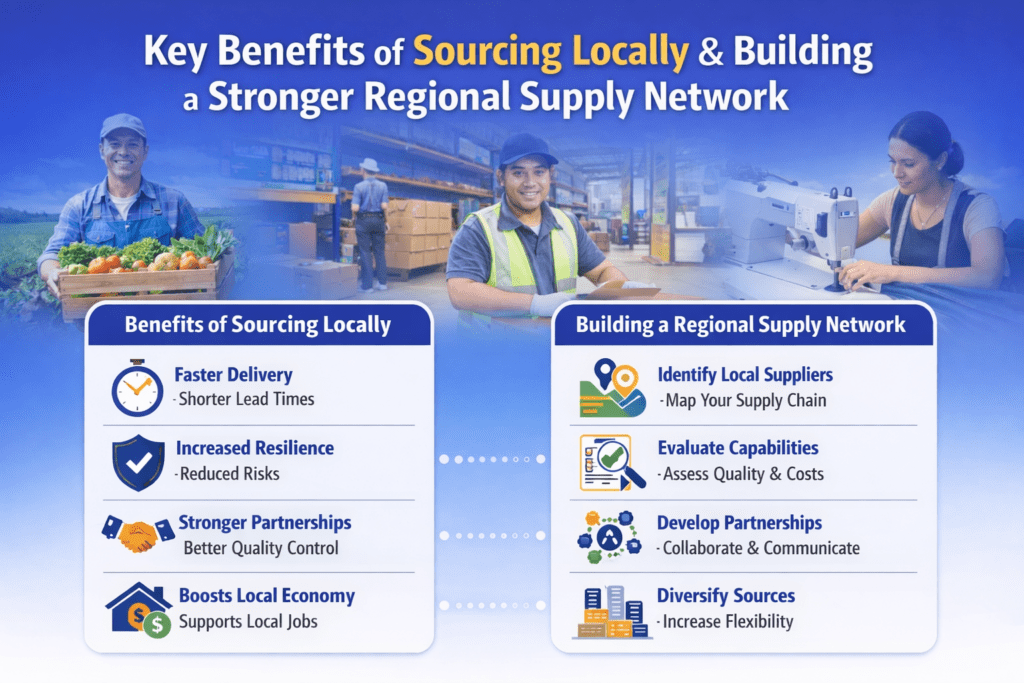
Localized supply chains help small businesses source products and services from suppliers close to their operations. By shortening the distance between buyer and supplier, small businesses gain reliability, agility, and community impact benefits that support growth and resilience. This blog explains how local supply chain strategies create competitive advantages for small businesses and why they matter today.
Why Localized Supply Chains Matter
Localized supply chains refer to sourcing goods and services from suppliers within the same region or nearby community. This approach reduces dependency on distant global networks and strengthens responsiveness, reduces risk, and improves operational efficiency. For small businesses, local supply chain strategies can mean faster delivery, stronger relationships with suppliers, and increased visibility into quality and costs.
Quick Facts
- $122.7 billion in small business spending in 2024 generated $202.7 billion in total economic output.
- Every $1 spent with small and local suppliers generated $1.65 in total economic value.
- 828,000 jobs supported across the United States through small supplier engagement.
- More than 90 percent of manufacturing leaders prioritize regional or localized supply strategies.
What Is a Localized Supply Chain?
A localized supply chain is a network of nearby manufacturers, suppliers, and distribution partners that serve a business’s operational needs within a defined geographic area. By focusing on regional resources, businesses reduce the complexity and risk associated with long-distance supply lines, and increase their ability to respond to change.
Benefits of Local Suppliers for Small Businesses
Faster Delivery and Shorter Lead Times
Small Business Advantage: Local suppliers cut down the time it takes to receive inventory, enabling small businesses to respond quickly to customer demand and reduce stockout risks.
Local sourcing often reduces lead times compared to international shipping and global transit delays.
Sourcing locally means products move shorter distances, helping small businesses restock faster and respond to demand changes without depending on long overseas transit times, which often cause delays.
Greater Supply Chain Resilience and Risk Reduction
Small Business Advantage: Localized supply chains are less vulnerable to global disruptions like pandemics, port congestion, trade tensions, and extreme weather events.
A report shows enterprises are increasingly obtaining supplies from nearby sources to strengthen resilience.
Local suppliers enable small businesses to manage disruptions better by reducing reliance on global networks that can be unpredictable and slow to recover during crises.
Stronger Supplier Relationships
Small Business Advantage: Working with local suppliers often leads to closer collaboration, more flexibility, and easier quality control. Being nearby allows in-person meetings, quicker problem resolution, and a deeper understanding of supplier capabilities.
Close relationships with local suppliers allow small businesses to work directly with partners, improving quality oversight and communication for better outcomes.
Economic Impact and Community Support
Small Business Advantage: Small business spending on local suppliers generates significant economic activity and jobs. In 2024, businesses spent $122.7 billion with small suppliers in the US, supporting 828,000 jobs and creating over $202.7 billion in economic output.
Every dollar invested locally multiplies economic benefits.
When small businesses source locally, they stimulate job creation, boost income, and circulate money back into the community, strengthening regional economies.
Reduced Transportation Costs
Small Business Advantage: Less distance traveled means lower shipping costs, fewer tariffs or customs fees, and reduced fuel expenses. Local suppliers can deliver more frequently and at lower cost than far-away producers.
Shorter transportation distances lower logistics costs, helping small businesses save money that would otherwise be spent on long-haul shipping, freight fees, and fuel.
Local vs Global Suppliers for Small Businesses
| Factor | Local Suppliers | Global Suppliers |
|---|---|---|
| Delivery Time | Faster due to proximity | Longer due to international transit |
| Cost Variability | Lower transportation costs | Potentially lower unit costs but high shipping fees |
| Quality Control | Easier in-person oversight | Limited by distance and communication barriers |
| Economic Impact | Boosts local jobs and communities | Benefits broader economies |
| Product Variety | May be limited | Larger selection, specialized items |
How Small Businesses Can Localize Their Supply Chains
1. Map Your Current Supply Chain
List current suppliers and identify opportunities to replace distant partners with local or regional ones. Understand where each input in your product or service comes from.
2. IdentifyLocal Suppliers
Use local business directories, chambers of commerce, and industry networks to find regional suppliers that match your requirements.
3. Evaluate Supplier Capabilities
Assess lead times, production capacity, quality standards, and pricing to ensure any local partner meets your business needs.
4. Build Strong Partnerships
Develop long-term contracts, collaborate on forecasting, and communicate regularly. Strong relationships help both sides plan for demand changes and quality expectations.
5. Diversify Within Local Networks
Avoid dependence on a single supplier by finding multiple local or regional partners. This increases supply chain resilience and flexibility.
Case Example: Small Business Wins With Local Supply
Retail Apparel Brand
A US-based fashion retailer shifted part of its production to nearby textile manufacturers after experiencing delays from overseas suppliers. With local partners, the brand reduced lead times from several weeks to days, responded faster to trending styles, and improved inventory precision.
Food Service Provider
A local cafe began sourcing dairy and produce from nearby farms. This reduced transportation costs, improved product freshness, and resonated with community values about sustainability and local support.
Challenges and Considerations
- Product Variety Limitations: Some specialized materials may not be available locally. Balancing local and global sources might be necessary.
- Higher Production Costs: Local suppliers sometimes have higher unit costs compared with overseas producers because of labor and scale differences.
- Capacity Constraints: Local suppliers may not always scale quickly during rapid demand growth, making diversification key.
Conclusion
Localized supply chains offer small business advantages in resilience, cost control, quality oversight, and community impact. Business leaders who invest in local suppliers can improve responsiveness to disruptions, support regional economies, and build stronger supply networks that adapt to customer needs.
If you want to strengthen your supplier diversity strategy or streamline your supply chain with local partners, contact STARS to explore supplier sourcing solutions tailored to small business success and community growth.
