Finding Hidden Small Business Enterprises: A Practical Guide to Data Enrichment for Supplier Diversity
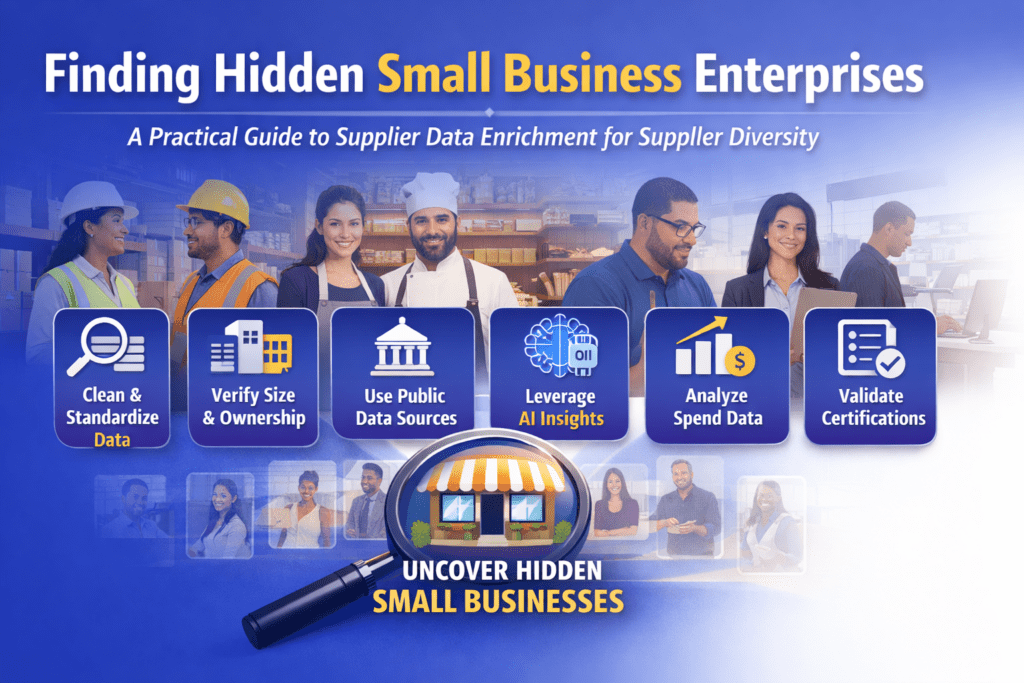
Finding small suppliers is one of the biggest challenges in modern supplier diversity programs. Many qualified small businesses remain invisible due to incomplete, outdated, or fragmented data. Supplier data enrichment solves this problem by expanding, validating, and enhancing supplier information so organizations can discover hidden small suppliers, strengthen supplier diversity, and reduce sourcing risk at scale.
Why Small Businesses Matter in Supplier Diversity Programs
Small businesses are the backbone of resilient and innovative supply chains. They bring agility, regional expertise, competitive pricing, and diverse ownership into procurement ecosystems. Yet many procurement teams struggle with small business supplier discovery because traditional databases favor large, well-documented vendors.
According to the U.S. Small Business Administration, small businesses account for over 99.9 percent of all U.S. businesses and employ nearly half of the private workforce. Despite this, they receive a disproportionately small share of corporate procurement spend.
Supplier diversity initiatives that intentionally prioritize small businesses help organizations meet regulatory requirements, unlock innovation, and strengthen local economies while improving supplier competition.
Recent Statistics Highlighting the Importance of Small Suppliers
- According to the U.S. Small Business Administration, 2023, small businesses created 70 percent of net new jobs over the past decade.
- According to National Minority Supplier Development Council (NMSDC), organizations with mature supplier diversity programs are 133 percent more likely to achieve higher procurement ROI than peers.
- According to the 2024 Supplier Diversity Economic Impact Report from Supplier.io, organizations collectively spent $168 billion with small and diverse suppliers, supporting more than 710,000 direct jobs and contributing $60 billion in direct wages. This spend also supported 1.4 million total jobs when including indirect and induced impact.
- According to the 2024 Supplier Diversity Economic Impact Report from Supplier.io, every $1 spent with small and diverse suppliers generated $1.80 in broader economic value, highlighting the multiplier effect of inclusive procurement.
What Is Supplier Data Enrichment?
Supplier data enrichment is the process of enhancing existing supplier records with accurate, verified, and expanded data from multiple external and internal sources. It helps procurement teams identify small businesses that are missing, misclassified, or hidden within legacy systems.
Supplier data enrichment typically includes:
- Business size verification
- Ownership and diversity classification
- Financial stability indicators
- Geographic and industry mapping
- Compliance and certification validation
By enriching supplier data, organizations gain visibility into small business suppliers they may already be working with or could source from but cannot currently find.
How Data Gaps Hide Small Business Suppliers
Many small businesses are invisible because procurement systems rely on incomplete or outdated data. This problem is especially common in legacy ERP, VMS, and vendor master files.
Common reasons small suppliers remain hidden:
- They are incorrectly classified as large enterprises
- Ownership and diversity certifications are missing
- Company names or addresses are inconsistent
- No digital footprint exists in traditional databases
Without supplier data enrichment, procurement teams unintentionally exclude small businesses from sourcing events, RFPs, and preferred supplier lists.
Finding Small Suppliers Using Data Enrichment Techniques
1. Clean and Standardize Existing Supplier Data
Cleaning and standardizing supplier data means removing duplicates, correcting naming inconsistencies, and validating core business details so small suppliers can be accurately identified and classified within procurement systems.
Start by auditing your vendor master file. Normalize company names, addresses, tax IDs, and contact information. This step alone often reveals small suppliers incorrectly grouped under parent corporations.
2. Append Firmographic and Ownership Data
Firmographic data provides insights into company size, revenue range, employee count, and industry classification. Ownership data identifies whether a supplier qualifies as small, minority-owned, woman-owned, veteran-owned, or disadvantaged.
Use trusted data sources such as:
- SBA Dynamic Small Business Search
- Dun & Bradstreet
- State and local certification databases
Appending this data transforms basic supplier lists into rich discovery tools.
3. Leverage Public and Government Data Sources
Public data sources help uncover small suppliers by offering verified business registrations, certifications, and compliance records that may not exist in commercial databases.
Authoritative sources include:
- https://www.sba.gov for small business certifications
- https://sam.gov for federal contractor registrations
- State procurement portals and local chambers of commerce
- .edu and .gov research datasets
These sources are especially valuable for finding niche and regional small businesses.
4. Use AI and Predictive Matching for Supplier Discovery
Advanced supplier data enrichment platforms use AI to identify patterns that signal small business status even when explicit data is missing.
AI models analyze:
- Website signals and digital presence
- Hiring trends and job postings
- Industry clustering and geographic density
- Financial proxies and payment histories
This approach significantly improves small business supplier discovery beyond manual searches.
5. Cross-Reference Internal Spend Data
Internal spend analysis often reveals small suppliers already doing business with your organization but not classified correctly.
Match enriched supplier profiles against:
- AP and invoice data
- Contract management systems
- VMS and MSP records
This allows procurement teams to retroactively count small supplier spend and bring those vendors into formal diversity programs.
6. Identify Small Businesses at Scale With STARS
STARS provides a structured, data-driven way to identify and validate small businesses across complex supplier ecosystems. By combining supplier data enrichment, certification verification, and advanced analytics, STARS helps organizations uncover small suppliers that are hidden due to data gaps, misclassification, or limited digital presence.
STARS enables procurement teams to:
- Accurately identify small and diverse suppliers across systems
- Validate size and ownership status using trusted data sources
- Continuously refresh supplier profiles as businesses evolve
- Improve supplier diversity reporting and compliance
This approach ensures small business supplier discovery is consistent, scalable, and aligned with enterprise supplier diversity goals.
Case Study: Uncovering Hidden Small Suppliers Through Enrichment
A Fortune 500 manufacturing company conducted a supplier data enrichment initiative across 120,000 vendor records. Before enrichment, only 8 percent of suppliers were identified as small businesses.
After enrichment:
- Small business identification increased to 19 percent
- Over 2,400 existing suppliers were reclassified as small businesses
- Supplier diversity spend reporting improved accuracy by 27 percent
- Sourcing teams gained access to 1,100 net-new small suppliers for RFPs
The project paid for itself within six months through better sourcing outcomes and compliance reporting.
Benefits of Supplier Data Enrichment for Supplier Diversity
Supplier data enrichment delivers measurable business value beyond compliance.
Key benefits include:
- Increased visibility into small and diverse suppliers
- More competitive sourcing and reduced dependency on large vendors
- Improved ESG and regulatory reporting
- Faster time-to-source for niche capabilities
- Stronger local and regional supplier ecosystems
Organizations that treat data enrichment as a continuous process outperform those that rely on static databases.
Key Takeaways: Quick Facts for Procurement Teams
- Small businesses are often hidden due to incomplete or outdated supplier data
- Supplier data enrichment improves accuracy, visibility, and diversity reporting
- Public, government, and AI-driven data sources are essential for discovery
- Enrichment helps uncover both new and existing small suppliers
- Strong data foundations enable scalable supplier diversity programs
Common Questions About Small Business Supplier Discovery
How does supplier data enrichment help find small suppliers?
Supplier data enrichment enhances existing records with verified size, ownership, and financial data, making it easier to identify small businesses that were previously misclassified or missing from procurement systems.
Is supplier data enrichment a one-time project?
No. Supplier data enrichment should be ongoing. Small businesses grow, merge, relocate, or change ownership, and continuous updates ensure supplier diversity data remains accurate and actionable.
Best Practices for Sustainable Supplier Data Enrichment
- Establish clear data governance ownership
- Refresh supplier data at least quarterly
- Integrate enrichment into onboarding workflows
- Validate certifications annually
- Align procurement, finance, and compliance teams
These practices ensure long-term success in finding small suppliers at scale.
Conclusion
Finding hidden small suppliers is not a sourcing problem. It is a data problem. Supplier data enrichment provides the visibility procurement teams need to build inclusive, resilient, and high-performing supply chains.
If your organization is looking to strengthen supplier diversity, improve small business supplier discovery, and modernize supplier data, contact STARS today to learn how advanced data enrichment solutions can transform your supplier ecosystem.

Marketing professional passionate about people, creativity, and meaningful growth. Proud to be part of the STARS team, empowering businesses to discover and manage diverse suppliers through one powerful platform.