What Is Supplier Diversity? Benefits & Best Practices
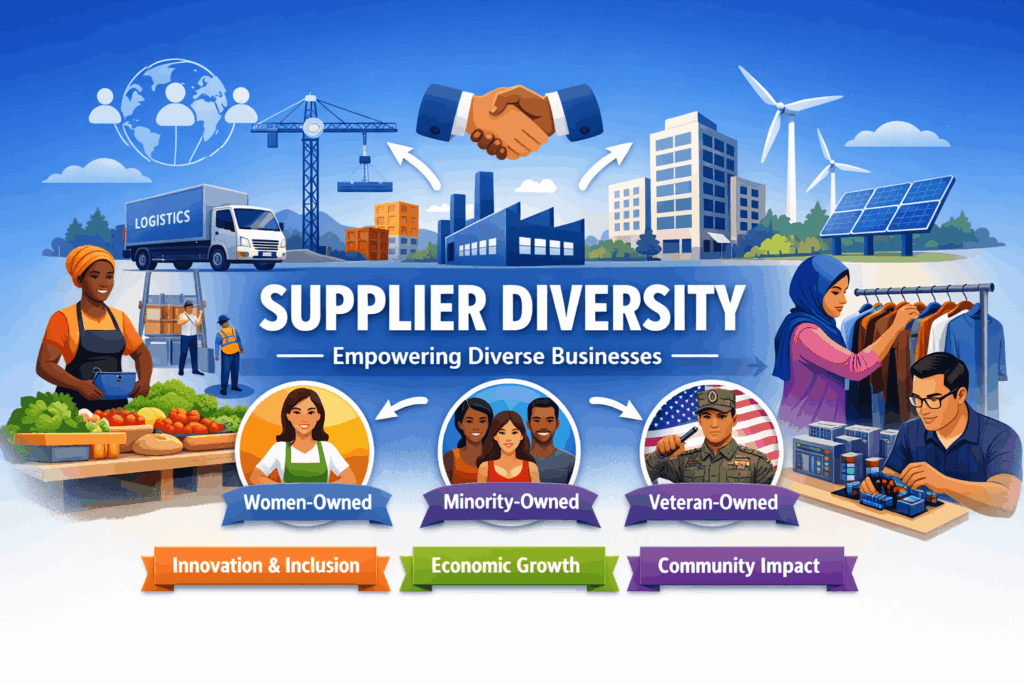
Supplier diversity is a strategic procurement approach in which organizations actively source from businesses owned by underrepresented groups, including minorities, women, veterans, LGBTQ+ individuals, and people with disabilities. It strengthens supply chain resilience, drives economic equity, and delivers measurable competitive advantages. This guide covers everything procurement and diversity leaders need to know about building, tracking, and managing an effective supplier diversity program.
What Is Supplier Diversity and Who Are Diverse Suppliers?
Supplier diversity is defined as a proactive business strategy that ensures a company’s supply chain includes vendors owned and controlled by at least 51% of individuals from historically underrepresented populations. It encompasses targeted outreach, certification verification, spend tracking, and supplier development to create equitable procurement ecosystems.
A diverse supplier is any business that meets the ownership, management, and operational control thresholds defined by accredited certifying organizations. Diverse suppliers operate across every industry, from healthcare and logistics to IT and staffing, and range from sole proprietorships to mid-market enterprises.
What Are the Recognized Categories of Diverse Suppliers?
The main diverse supplier categories recognized by U.S. certifying bodies include:
- Minority-Owned Business Enterprises (MBEs): Owned and controlled by individuals who belong to a racially or ethnically underrepresented group, as recognized by the National Minority Supplier Development Council (NMSDC).
- Women-Owned Business Enterprises (WBEs): Owned and controlled by women, as certified by the Women’s Business Enterprise National Council (WBENC).
- Veteran-Owned Small Businesses (VOSBs) and Service-Disabled Veteran-Owned Small Businesses (SDVOSBs): Businesses majority-owned and operated by U.S. military veterans or veterans with service-connected disabilities, recognized and certified by the U.S. Department of Veterans Affairs and the Small Business Administration (SBA).
- LGBTQ+-Owned Business Enterprises (LGBTBEs): Owned and controlled by individuals who identify as part of the LGBTQ+ community, as certified by the National LGBT Chamber of Commerce (NGLCC).
- Disability-Owned Business Enterprises (DOBEs): Owned and controlled by individuals living with a documented disability, as certified by Disability:IN, formerly the U.S. Business Leadership Network.
- HUBZone Small Businesses: Small businesses that operate and employ workers in Historically Underutilized Business Zones designated by the SBA, typically in economically distressed communities.
- Small Disadvantaged Businesses (SDBs): Small businesses owned by individuals who are socially and economically disadvantaged, qualifying under the SBA’s 8(a) Business Development Program.
How Does Diversity Certification Work?
Diversity certification is the formal verification process through which a business confirms its ownership and control status with an accredited third-party certifying body. Certification provides the credibility layer that allows corporations and government agencies to count vendor spending toward documented supplier diversity goals.
The certification process typically includes:
- Submission of ownership documentation, articles of incorporation, and financial statements.
- Verification of operational control by members of the qualifying underrepresented group.
- A site visit or structured interview conducted by the certifying organization.
- Annual or biennial renewal requirements depending on the certifying body.
Key U.S. certifying bodies include NMSDC (MBE), WBENC (WBE), SBA (8a/HUBZone/SDVOSB/WOSB), NGLCC (LGBTBE), and Disability:IN (DOBE).
Why Supplier Diversity Is Important for Business Performance and Society
Supplier diversity is important because it simultaneously delivers financial performance, supply chain resilience, regulatory compliance, and lasting economic impact in underserved communities. According to a 2021 Hackett Group report, companies with mature supplier diversity programs achieve 133% greater procurement ROI than peers without structured programs.
Supplier diversity has also become a formal stakeholder expectation. A 2022 Gartner survey found that 85% of procurement leaders said supplier diversity had become an organizational priority, driven by investor ESG requirements, customer brand preferences, and employee values alignment.
Why Supplier Diversity Is Important for Competitive Advantage
Here are the top six competitive reasons why supplier diversity matters for businesses in 2024 and beyond:
- Supply chain resilience: A diversified vendor base reduces single-source dependency and lowers disruption risk, a lesson reinforced by the COVID-19 supply chain breakdowns of 2020 and 2021.
- Innovation access: Diverse-owned businesses often serve niche markets or apply unconventional problem-solving approaches, surfacing solutions that incumbent suppliers overlook.
- Cost optimization: Introducing diverse suppliers into competitive bidding increases market tension, historically lowering procurement costs by 3 to 8 percent in categories where supplier diversity targets are active.
- ESG credibility: ESG frameworks including GRI (Global Reporting Initiative) and SASB (Sustainability Accounting Standards Board) include supply chain diversity as a tracked social metric.
- Government contract eligibility: Federal contractors operating under FAR (Federal Acquisition Regulation) Subpart 19 must demonstrate supplier diversity commitments through formal subcontracting plans.
- Talent attraction: Studies by Deloitte and McKinsey consistently show that employees, especially those under 40, prefer employers whose procurement values align with equity and inclusion.
Why Supplier Diversity Is Important for Economic Impact
The economic impact of supplier diversity extends far beyond individual vendor contracts. The NMSDC reports that certified minority-owned businesses generate over $400 billion in annual economic output and employ more than 2.2 million workers in the United States.
When corporations direct meaningful spend toward diverse suppliers, a community multiplier effect occurs:
- Diverse business owners reinvest a higher proportion of earnings in their local communities compared to non-diverse firms.
- Job creation in HUBZones and underserved urban and rural areas reduces unemployment gaps and raises median household income.
- Entrepreneurs from underrepresented groups gain access to capital, procurement networks, and long-term contracts that compound over generations.
- Local tax revenues grow, funding public schools, infrastructure, and community services.
The U.S. Department of Commerce’s Minority Business Development Agency (MBDA) estimates that closing the entrepreneurship gap between minority and non-minority business owners could add $2.3 trillion to U.S. GDP.
Key Benefits of Supplier Diversity Programs
The benefits of supplier diversity are measurable across financial, operational, reputational, and social dimensions. Organizations that build structured programs with dedicated supplier diversity officers, real-time spend tracking, and formal supplier development initiatives consistently outperform peers on both procurement efficiency and ESG benchmarks.
Here are the core benefits of supplier diversity programs, organized by category:
| Benefit Category | Business Impact | Social Impact |
|---|---|---|
| Supply chain resilience | Reduces single-source dependency risk | Distributes economic opportunity equitably |
| Innovation pipeline | Access to niche expertise and emerging technology | Supports entrepreneurship in underserved communities |
| Cost optimization | Competitive bidding reduces procurement costs | Encourages growth in HUBZone businesses |
| ESG and brand equity | Strengthens investor and consumer trust | Advances racial and gender economic equity |
| Regulatory compliance | Meets federal FAR subcontracting requirements | Aligns with civil rights and equity legislation |
| Talent acquisition | Preferred employer status among diverse talent pools | Creates visible role models in communities |
In 2023, Walmart publicly reported over $13.1 billion in spending with diverse suppliers. Apple committed $100 million through its Racial Equity and Justice Initiative (REJI) in 2021 to accelerate diverse supplier development. These public commitments signal to the market that supplier diversity is a board-level business strategy, not a compliance checkbox.
Understanding Tier 1 and Tier 2 Supplier Diversity Tracking
The difference between Tier 1 and Tier 2 supplier diversity is that Tier 1 tracks direct spend between a buying organization and certified diverse vendors, while Tier 2 tracks the diverse subcontracting spend of a buying company’s primary (non-diverse) suppliers on the buyer’s behalf. Both tiers are essential to a complete supplier diversity tracking strategy.
What Is Tier 1 Supplier Diversity?
Tier 1 supplier diversity refers to direct procurement relationships between a corporation and a certified diverse vendor. If a hospital system contracts directly with a Black-owned medical supply company, that spend is recorded as Tier 1 diverse spend. Tier 1 is the simplest to measure because it appears directly in the buyer’s accounts payable and procurement records.
What Is Tier 2 Supplier Diversity?
Tier 2 supplier diversity refers to the diverse subcontracting spend generated by a company’s non-diverse prime suppliers when they engage certified diverse businesses on the buyer’s behalf. For example, if a large technology integrator (prime supplier) subcontracts 18% of a project to a Hispanic-owned cybersecurity firm, the buyer can credit that subcontracted spend as Tier 2 diverse spend.
Tier 2 programs expand the practical reach of supplier diversity initiatives, allowing large enterprises to credit diverse spend in categories where direct engagement with small diverse firms is operationally impractical.
| Feature | Tier 1 | Tier 2 |
|---|---|---|
| Relationship type | Direct buyer-to-diverse vendor | Prime supplier-to-diverse subcontractor |
| Measurement method | Internal accounts payable data | Prime supplier self-reporting |
| Operational complexity | Lower | Higher (requires supplier data submissions) |
| Coverage | Limited to direct spend | Extends throughout supply chain |
| Typical users | All companies with programs | Large enterprises and federal contractors |
General Motors and Ford have operated structured Tier 2 supplier diversity reporting programs for over 20 years, making them benchmarks in automotive industry supplier diversity tracking practices.
Best Practices in Supplier Diversity Program Management
The best practices in supplier diversity are built around four structural pillars: leadership commitment, infrastructure investment, supplier development, and data-driven measurement. Organizations that treat supplier diversity as a procurement strategy rather than a public relations initiative consistently see the most durable results.
How to Build an Effective Supplier Diversity Program Step by Step
Here are the top eight best practices that leading supplier diversity professionals recommend:
- Secure executive sponsorship. Designate a C-suite champion (typically the Chief Procurement Officer or Chief Diversity Officer) responsible for supplier diversity goals, budgets, and quarterly reporting.
- Set measurable spend targets. Establish annual percentage-of-spend goals for Tier 1 and Tier 2 diverse vendors, segmented by business unit and commodity category.
- Join certifying body networks. Become a corporate member of NMSDC, WBENC, or NGLCC to access pre-vetted databases of certified diverse suppliers organized by industry and geography.
- Use a dedicated supplier diversity management portal. Purpose-built platforms such as STARS (Supplier Management Portal) consolidate supplier registration, supplier engagement, certification tracking, spend analytics, and economic impact reporting into a single system of record.
- Embed diversity criteria in RFPs. Include supplier diversity as a scored evaluation factor in Request for Proposal (RFP) rubrics so that diverse vendor participation is a formal, documented award consideration.
- Run supplier development programs. Offer supply chain finance access, technical workshops, reverse trade shows, and long-term contract pathways that help diverse businesses scale and build capacity.
- Track and report spend in real time. Use procurement platforms such as SAP Ariba, Jaggaer, or STARS to tag diverse spend at the point of purchase order creation and generate quarterly and annual diversity reports.
- Publish an annual supplier diversity report. Transparent public reporting builds credibility with investors, customers, regulators, and the supplier community.
How STARS Powers Supplier Diversity Tracking and Management
The STARS Supplier Management Portal (STARS) is a purpose-built supplier diversity management portal that helps organizations consolidate supplier registration, automate certification verification, track Tier 1 and Tier 2 diverse spend, and generate economic impact reports across complex, multi-entity supply chains. STARS has been deployed across healthcare, insurance, food and beverage, and transportation industries.
The following case studies illustrate how STARS transforms supplier diversity tracking from a manual compliance burden into a strategic business capability.
Case Study 1 — Midwest Insurance Company: Enhancing Supplier Diversity Insights Through Data Enrichment
A leading Midwest insurance company faced a fragmented supplier diversity data environment. Vendor certification records were maintained in disconnected spreadsheets, and procurement teams lacked the analytics infrastructure needed to produce reliable Tier 1 and Tier 2 diverse spend reports for executive leadership and regulatory stakeholders.
By deploying the STARS supplier diversity management portal, the company consolidated its supplier data into a unified system enriched with real-time certification status, ownership demographics, and NAICS code classifications. The result was a structured analytics environment that enabled procurement teams to identify spend gaps by diversity category, generate board-ready diversity reports, and proactively target underperforming spend categories for diverse vendor development. The engagement demonstrated how data enrichment transforms raw procurement records into actionable supplier diversity intelligence.
Source: STARS Case Study — Midwest Insurance Company
Case Study 2 — Global Food and Beverage Corporation: Building a Unified Supplier Diversity and Spend Reporting Platform
A global food and beverage corporation with operations across multiple continents struggled to produce a consolidated view of supplier diversity spend across its decentralized business units. Business unit procurement teams used inconsistent vendor tagging conventions, making it impossible to aggregate accurate enterprise-wide diversity spend figures.
STARS built a unified supplier diversity and spend reporting platform that standardized data taxonomy across all business units, integrated with existing ERP systems, and automated the consolidation of Tier 1 and Tier 2 diverse spend into a single executive dashboard. The platform reduced reporting cycle time significantly and enabled the corporation to make credible public supplier diversity disclosures aligned with GRI social reporting standards. The engagement illustrated how a centralized supplier registration portal eliminates the data inconsistencies that undermine enterprise-wide supplier diversity programs.
Source: STARS Case Study — Global Food and Beverage Corporation
Case Study 3 — Rental Car Client: Transforming Global Data Consolidation and Diversity Spend Reporting
A major rental car company with a multinational supplier base needed to reconcile diversity spend data across operations in North America, Europe, and Asia-Pacific. The absence of a standardized supplier registration portal and a globally consistent diversity taxonomy made cross-border diversity spend reporting both time-consuming and unreliable.
STARS implemented a global data consolidation framework that harmonized supplier diversity classifications across geographies, enabling the rental car client to produce consistent, audit-ready diversity spend reports aligned with both U.S. and international procurement equity standards. The project highlighted how supplier diversity tracking at global scale requires both a robust technology platform and a disciplined data governance framework.
Source: STARS Case Study — Rental Car Client
Case Study 4 — Healthcare System: Advancing Supplier Diversity and Economic Impact Using the STARS Framework
A regional healthcare system sought to move beyond compliance-driven supplier diversity reporting toward a strategy that could demonstrate measurable community economic impact. Procurement leadership needed tools that could quantify how diverse vendor spend translated into local job creation, wage growth, and community reinvestment in the communities the health system served.
STARS deployed its economic impact modeling framework alongside its core supplier management portal, enabling the health system to calculate and communicate the downstream economic multiplier effect of its diverse procurement spending. This capability elevated the organization’s supplier diversity program from a regulatory checkbox to a documented community investment strategy, strengthening relationships with local elected officials, community organizations, and diverse business advocacy groups.
Source: STARS Case Study — Healthcare Economic Impact
Case Study 5 — Healthcare Provider: Transforming Supplier Diversity from Compliance Burden to Strategic Community Impact
A second healthcare provider client had historically managed its supplier diversity program as a compliance obligation, maintaining minimal documentation to satisfy regulatory requirements. Program staff spent the majority of their time on manual data collection rather than supplier development or community engagement.
STARS restructured the organization’s supplier diversity management operations by implementing its supplier registration portal, automating certification tracking, and building a real-time diverse spend dashboard integrated with the provider’s existing procurement workflow. With administrative burden reduced through automation, the supplier diversity team redirected staff capacity toward strategic supplier development initiatives, reverse trade show programming, and community economic impact storytelling. The case study documented how the right supplier diversity management platform transforms program operations from reactive compliance reporting to proactive community investment.
Source: STARS Case Study — Healthcare Provider, Compliance to Community Impact
What Is a Supplier Diversity Concierge Service?
A supplier diversity concierge service is a dedicated support function, either internal or third-party managed, that guides both buyers and diverse suppliers through the complexities of certification, registration, onboarding, and program participation. Concierge services reduce the friction that small and emerging diverse businesses often face when attempting to qualify and compete in large enterprise procurement processes.
Core functions of a supplier diversity concierge service include:
- Guiding diverse businesses through national and regional certification applications with NMSDC, WBENC, SBA, or other bodies.
- Managing supplier registration portal onboarding so that diverse vendors are accurately profiled, tagged, and matched to open procurement opportunities.
- Providing diversity spend reporting support to procurement teams who need to reconcile Tier 1 and Tier 2 data for internal dashboards or external stakeholder reports.
- Facilitating introductions between certified diverse suppliers and category managers across business units.
- Delivering ongoing education and readiness training to help diverse businesses understand corporate procurement requirements and build competitive proposals.
Platforms like STARS embed concierge service capabilities directly into their supplier registration portal, allowing program managers to combine automated supplier onboarding with human-assisted support for complex certification scenarios.
Conclusion: Supplier Diversity Is a Strategic Business Imperative
Supplier diversity is no longer a voluntary CSR initiative. It is a measurable competitive strategy that delivers supply chain resilience, procurement cost reduction, and ESG credibility while generating economic equity in underserved communities. Three key takeaways: first, certified diverse suppliers create direct business value through innovation, competition, and community alignment. Second, structured Tier 1 and Tier 2 tracking with a purpose-built supplier diversity management portal is the operational backbone of high-performing programs. Third, as STARS case studies across healthcare, insurance, food and beverage, and transportation demonstrate, the right technology transforms supplier diversity from a compliance burden into a board-level strategic asset.
Ready to elevate your supplier diversity program? Contact STARS today to schedule a demo of the industry’s leading supplier registration portal and spend reporting platform, or download the STARS Supplier Diversity Best Practices Guide to start building a program that delivers measurable impact.
Help Center
Frequently asked questions
Supplier diversity is a procurement strategy that ensures a company's vendor base includes businesses that are at least 51 percent owned by underrepresented groups such as minorities, women, veterans, and LGBTQ+ individuals. It is important because it strengthens supply chain resilience, increases cost competition, enhances ESG performance, and supports community economic development.

Marketing professional passionate about people, creativity, and meaningful growth. Proud to be part of the STARS team, empowering businesses to discover and manage diverse suppliers through one powerful platform.