
Case Study: Building a Unified Supplier Diversity and Spend Reporting Platform for a Global Food and Beverage Corporation
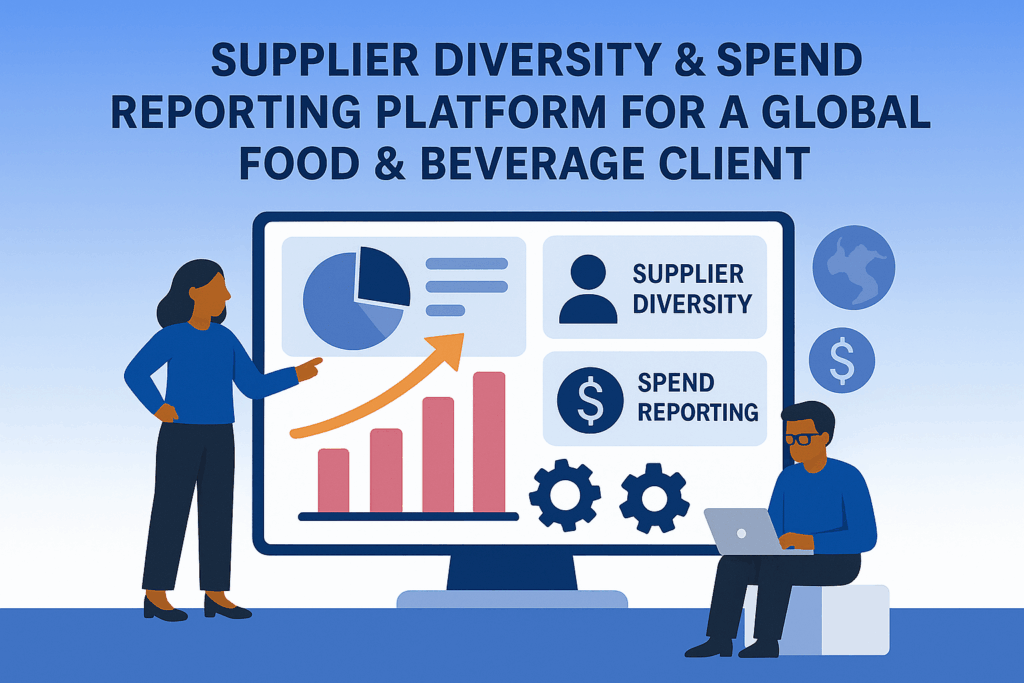
One of the world’s largest food and beverage corporations identified a critical need to modernize its supplier diversity and spend reporting infrastructure. The company operates across multiple divisions, brands, and subsidiaries, with a procurement network that spans thousands of suppliers worldwide. Its mission to promote inclusion and equity extended beyond internal policies and into the supply chain. However, existing tools and fragmented processes limited the company’s ability to measure, manage, and communicate its supplier diversity performance effectively.
The procurement and supplier diversity teams faced growing complexity as they attempted to collect, analyze, and report diversity spend data across business units. Information was scattered across systems and business functions, and manual reporting created inconsistencies and inefficiencies. Leadership recognized that these challenges were not only administrative but strategic. Without a comprehensive solution, the organization risked missing valuable opportunities to strengthen its partnerships with diverse suppliers and to communicate its economic impact transparently to stakeholders.
To address these challenges, the company partnered with STARS to design and implement a unified solution based on the STARS framework. The objective was to develop a system that could integrate seamlessly with the company’s existing procurement suite, automate data exchange, enrich and validate supplier diversity information, and generate consistent, actionable insights across all divisions.
Client’s Requirements
The company’s procurement and supplier diversity teams defined several specific goals for the new system. Each requirement reflected both current operational pain points and long-term strategic ambitions.
1. Seamless Integration with Procurement Systems
The solution needed to integrate with the organization’s Bravo procurement environment, which served as its enterprise-wide purchasing and contract management platform. The integration would enable automatic synchronization of supplier records, spend data, and certification updates, ensuring that both systems reflected accurate and current information at all times.
2. User-Friendly Data Enrichment Tools
The teams required an intuitive front-end interface that would allow both internal users and prime suppliers to review, enrich, and validate diversity data before synchronization. The tool had to be simple enough for non-technical users but powerful enough to maintain data integrity across all divisions.
3. Consolidated Reporting Across Divisions and Subsidiaries
The company’s multi-division structure meant that data collection and reporting were fragmented. Each business unit had its own methods and formats for tracking supplier diversity spend. The new platform needed to unify this process by consolidating data into a single system capable of supporting both direct reporting and aggregated reporting from subsidiaries and supplier networks.
4. Support for Custom Analytics and Reporting
The procurement leadership required a flexible reporting engine that could produce detailed, customized reports for internal and external stakeholders. Reports had to be configurable by supplier type, geography, category, division, and program. This would allow the supplier diversity team to analyze trends, monitor performance, and demonstrate impact across multiple dimensions.
5. Scalability and Future-Readiness
The organization emphasized that the solution should not only meet current requirements but also be capable of evolving with future business needs. The system needed to handle a growing volume of data, adapt to new compliance frameworks, and support enhancements without requiring a complete redesign.
6. Enhanced Supplier Collaboration
Finally, the company wanted a system that would strengthen its relationships with prime suppliers and diverse vendors. By improving visibility and simplifying reporting, the new solution would foster trust and encourage greater participation from the supplier community.
STARS’ Solution
After conducting a series of workshops with the client’s IT, business, and supplier diversity teams, STARS proposed a comprehensive solution built on its Supplier Transparency and Reporting System (STARS) framework. The framework was tailored specifically for large, multi-division enterprises that required advanced integration, flexible reporting, and scalability.
Key Elements of the Solution
1. Integration with the Bravo Procurement Suite
STARS engineered a robust two-way integration to enable seamless communication between the procurement suite and the STARS platform. This allowed supplier profiles, spend transactions, and certification details to remain synchronized. Any update made in one system would automatically reflect in the other, ensuring that data remained consistent and accurate across the enterprise.
2. Centralized Data Repository
All supplier diversity and spend data were consolidated into a single repository. This eliminated redundancy and provided a unified, enterprise-level view of performance. The system became the single source of truth for supplier diversity metrics.
3. Data Enrichment and Validation Layer
A front-end interface was developed to empower users to enrich and validate supplier diversity data before synchronization. This process ensured that the information flowing into the Bravo system was both accurate and standardized.
4. Unified Reporting Framework
The platform aggregated diversity spend data from all operating divisions and subsidiaries, consolidating direct and indirect spend. It allowed prime suppliers to report their own spend, while internal teams could view both rolled-up and granular details.
5. Customizable Dashboards and Reports
The STARS framework provided real-time dashboards that allowed users to filter and analyze supplier diversity data by category, location, and division. Leadership could easily generate compliance reports or executive summaries without requiring technical support.
6. Scalable and Modular Architecture
The system was designed to be modular, allowing new features and integrations to be added without disrupting existing operations. This future-ready approach ensured that the solution could evolve alongside changing business needs and compliance requirements.
7. Training and Change Management
STARS implemented a comprehensive training program for internal staff and external suppliers. Training sessions focused on data entry, reporting, and analytics, ensuring that all users could operate the system effectively and confidently.
Implementation Approach
The deployment of the STARS solution was managed in a structured, phased approach to ensure smooth integration, minimal disruption, and maximum adoption.
1. Discovery and Requirements Gathering
The STARS team collaborated with the client’s leadership to identify technical dependencies, existing workflow gaps, and key integration points. This stage also involved mapping data structures and designing the framework for synchronization with the Bravo procurement suite.
2. System Design and Development
Based on the findings, the technical team customized the STARS framework to align with the client’s business processes. Interfaces were designed for each user group, including internal procurement staff, prime suppliers, and subsidiary managers.
3. Integration and Testing
STARS developed secure data exchange protocols to ensure reliable communication between systems. Rigorous testing was performed to validate data accuracy and confirm that updates flowed seamlessly between the two platforms.
4. User Acceptance Testing (UAT)
Business users participated in UAT sessions to validate usability, performance, and data accuracy. Feedback from these sessions guided final refinements to workflows and dashboard design.
5. Training and Go-Live
The final rollout included hands-on training for internal teams and supplier partners. The implementation was completed on schedule, and the system was successfully launched across multiple divisions.
Business Impact
The introduction of the STARS platform transformed the client’s supplier diversity and reporting operations. The solution delivered both immediate process improvements and long-term strategic value.
1. Operational Efficiency
The automation of data exchange between systems significantly reduced manual effort. The new process eliminated the need for multiple spreadsheets and manual uploads, which had previously consumed extensive time and resources. As a result, the procurement teams could focus on more strategic activities such as supplier development and performance management.
2. Improved Data Accuracy and Consistency
Real-time synchronization between the STARS platform and the procurement system ensured that supplier records and spend data were always accurate and up to date. The validation process minimized errors, while centralized storage prevented duplication.
3. Enhanced Visibility and Decision-Making
The system provided leadership with a comprehensive, enterprise-wide view of supplier diversity metrics. They could now analyze spend distribution, track progress toward goals, and identify opportunities for targeted supplier engagement. Reports that once took weeks to compile were now generated within minutes.
4. Strengthened Supplier Relationships
Prime suppliers and diverse vendors benefited from a transparent, user-friendly interface that simplified data submission and reporting. The new platform encouraged more consistent participation from suppliers and improved communication between vendors and the procurement team.
5. Compliance and Risk Management
The unified reporting system ensured full compliance with both internal governance standards and external reporting requirements. Audit trails were automatically generated, and data integrity could be verified at any time.
6. Scalability for Future Growth
The modular structure of the STARS solution allowed the company to easily expand its capabilities as its business evolved. Future enhancements such as additional reporting modules or integration with third-party analytics tools could be implemented without major system overhauls.
7. Cultural and Strategic Impact
Beyond operational gains, the implementation reinforced the organization’s broader commitment to equity and inclusion. By giving leadership visibility into the tangible impact of supplier diversity, the system helped translate corporate values into measurable outcomes.
Feedback and Outcomes
Both internal stakeholders and external partners recognized the success of the project. The supplier diversity team highlighted that the new platform allowed them to manage data more proactively and communicate results with greater confidence.
Prime suppliers described the interface as intuitive and efficient, noting that it transformed reporting from a burdensome process into a collaborative experience. The user experience was frequently cited as a differentiator, with suppliers emphasizing that the platform made compliance easier and encouraged active engagement.
Internally, the procurement leadership commended the STARS team for its deep understanding of supplier diversity processes, attention to technical detail, and ability to align technology with long-term strategy. The project was completed within the agreed timeline, and STARS provided extensive post-implementation support and documentation to ensure smooth ongoing operations.
Conclusion
By partnering with STARS, the global food and beverage corporation achieved a significant leap forward in supplier diversity and spend management. The implementation of the STARS framework replaced fragmented workflows with an integrated, data-driven system that unified all aspects of supplier diversity reporting.
The results were tangible: higher data accuracy, faster reporting cycles, and stronger collaboration with suppliers. More importantly, the company gained the ability to quantify the impact of its supplier diversity efforts across regions, categories, and communities.
The project demonstrated that technology and inclusion can work hand in hand to create business value and social impact. With a scalable, transparent, and user-friendly platform, the company transformed supplier diversity from a reporting obligation into a strategic asset that advances both its business and its community mission.
Empower your supply chain with STARS. Reach out today to elevate your supplier diversity strategy.

Marketing professional passionate about people, creativity, and meaningful growth. Proud to be part of the STARS team, empowering businesses to discover and manage diverse suppliers through one powerful platform.