Supplier ESG Reporting: How to Track Sustainability, Labor & Governance KPIs Across Your Supply Chain
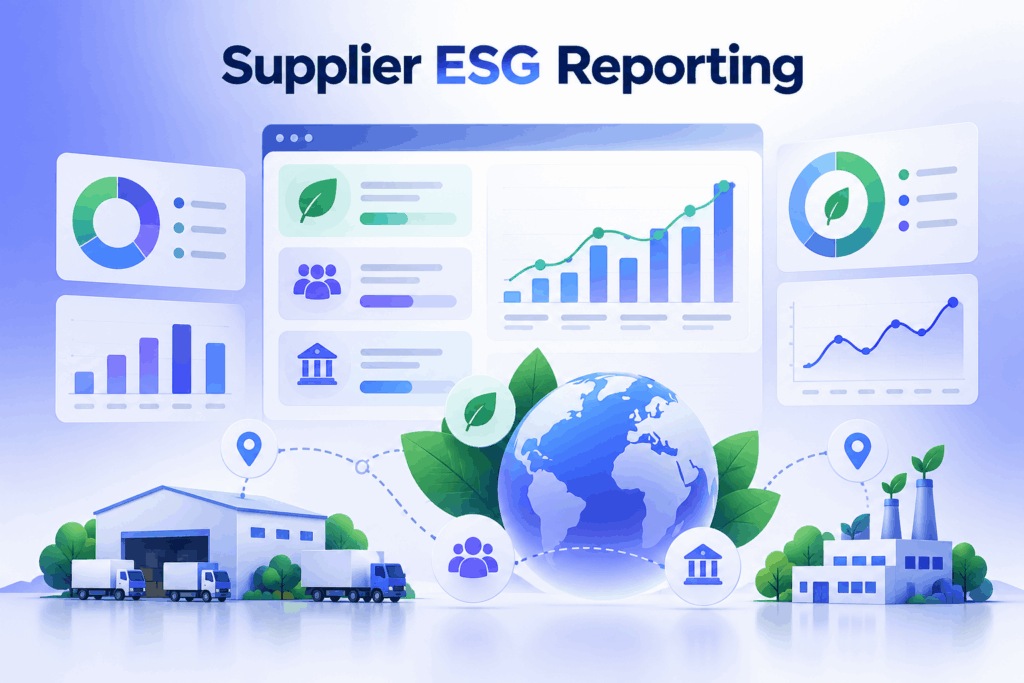
Supplier ESG reporting is defined as the structured process of collecting, verifying, and disclosing environmental, social, and governance data from vendors across a supply chain. Companies use supplier ESG software and standardized KPIs to monitor sustainability, labor practices, and governance compliance, reducing risk and meeting regulatory disclosure requirements.
Key Takeaways
- Supplier ESG reporting tracks three KPI groups: environmental, social (labor, safety), and governance (ethics, certifications).
- Deloitte (2025) found only 38% of companies required suppliers to meet sustainability criteria, down from 47% in 2022.
- The global ESG software market hit 1.2 billion USD in 2025, projected to reach 5.2 billion USD by 2033 (Grand View Research, 2026).
- EcoVadis (2026) found only 48% of buyers have ESG visibility into most Tier 1 suppliers.
- Deloitte (2024) reports 64% of companies distrust supplier-reported Scope 3 emissions data.
- Supplier ESG software, ESG reporting services, and harmonization platforms are core tools for certifications and diversity tracking.
Supplier ESG Reporting Statistics You Should Know
Recent data shows supplier ESG reporting is becoming standard practice, though gaps in supplier data quality and upstream visibility remain widespread across global supply chains.
- According to Deloitte (2025), only 38% of companies required suppliers or partners to meet sustainability criteria in 2025, down from 47% in 2022.
- According to Deloitte (2024), 64% of companies lack confidence in the Scope 3 emissions data they receive directly from suppliers.
- According to Grand View Research (2026), the global ESG software market was valued at 1.2 billion USD in 2025 and is projected to reach 5.2 billion USD by 2033.
- According to Supply Chain Dive (2023), only 38% of businesses were tracking Scope 3 emissions across their supply chain, based on an IBM and Morning Consult survey.
- According to EcoVadis (2026), only 48% of buyers have ESG visibility into most of their Tier 1 suppliers, with visibility dropping sharply beyond Tier 1.
What Is Supplier ESG Reporting and Why It Matters
Supplier ESG reporting is the practice of gathering environmental, social, and governance data from every vendor and turning it into standardized, auditable KPIs. It matters because regulators and customers now hold buying companies accountable for supplier practices.
Procurement teams rely on supplier ESG reporting to flag risks such as forced labor, unsafe conditions, or missing certifications before they become liabilities. Most emissions and labor risk sit upstream, so disclosures without it stay incomplete.
This is where visibility usually breaks down beyond Tier 1. STARS supplier success platform, pairs its External Supplier Locator with Tier 2 Spend Reporting so procurement teams can identify and onboard verified suppliers further upstream, rather than losing visibility the moment a Tier 1 vendor subcontracts work out.
What ESG KPIs Should Companies Track Across Their Supply Chain?
Supplier ESG KPIs fall into three groups. Environmental KPIs include Scope 3 emissions and waste diversion. Social KPIs include living wage compliance, working hours, and diversity spend. Governance KPIs include certifications held, ethics policies, and audit completion rates.
- Environmental: carbon footprint, renewable energy use, water stewardship
- Social: fair labor standards, child labor prevention, worker grievance mechanisms
- Governance: ISO certifications, code of conduct sign-off, anti-corruption training
A scorecard can only track what it is built to capture, and most off-the-shelf templates stop well short of a full ESG picture. STARS’ ESG Reporting module supports up to 200 customizable data points across environmental, social, and governance categories, with client-defined scoring criteria, so a team can track the specific mix of emissions, labor, and governance KPIs its industry and regulators actually require instead of a generic checklist.
What Is the Difference Between Supplier ESG Reporting and a Standard Supplier Audit?
The difference between supplier ESG reporting and a standard supplier audit is scope and frequency. A supplier audit is a point-in-time inspection, usually annual, checked against a fixed checklist. Supplier ESG reporting is continuous, KPI-based monitoring using dashboards and automated data feeds.
How Supplier ESG Software Streamlines ESG Reporting and Governance Tracking
Supplier ESG software automates the collection, scoring, and monitoring of supplier sustainability data so procurement teams do not rely on manual spreadsheets. Platforms such as EcoVadis, Sedex, Assent, and D&B ESG Intelligence pull data directly from suppliers and certification bodies into one dashboard.
These platforms replace spreadsheet tracking with automated scorecards and real-time alerts. Dun & Bradstreet notes that fragmented supplier data is a leading cause of incomplete ESG disclosures for mid-size and enterprise buyers.
Fragmented data is also a scoring problem, not just a collection problem: a duplicate or unverified supplier record throws off the score built on top of it. STARS addresses this at the data layer with a scrubbing and enrichment engine that validates supplier records before they feed into a scorecard, reaching up to 98% match accuracy for top-tier records, which directly targets the kind of Scope 3 data distrust Deloitte found among 64% of companies.
| Factor | Manual ESG Tracking | Supplier ESG Software |
|---|---|---|
| Data collection | Emails, spreadsheets, PDFs | Automated supplier portals and API feeds |
| Update frequency | Annual or ad hoc | Continuous, real-time alerts |
| Audit trail | Inconsistent, hard to verify | Centralized, timestamped, exportable |
| Scalability | Difficult beyond 50 to 100 suppliers | Scales to thousands of suppliers and Tier 2 or 3 |
| Regulatory readiness | Reactive, labor intensive | Built-in frameworks (CSRD, CSDDD, SEC) |
How Does STARS Support Supplier Tracking?
STARS ESG software refers to supplier ESG platforms that assign scorecard ratings, often shown as star ratings, to rank vendors by sustainability, labor, and governance performance. Buyers use these ratings to prioritize supplier development and benchmark performance across environment, labor, and ethics categories.
STARS own supplier success platform, is a literal example of this category. Its ESG Reporting module assigns client-defined scores across environmental, social, and governance categories and aligns them with GRI, CSRD, TCFD, and SEC reporting frameworks, then rolls those scores into the same dashboards the platform already uses for spend and supplier diversity tracking, so a buyer isn’t checking one system for cost and delivery and a separate one for sustainability.
Top Tools for Supplier ESG Monitoring, Sustainability KPIs, and Diversity Tracking
Top tools for supplier ESG monitoring combine sustainability tracking, labor oversight, and supplier diversity data in one platform. Sustainability tech vendors such as EcoVadis, Sphera, IntegrityNext, and Coupa integrate ESG scoring into sourcing workflows for direct comparison.
STARS belongs in that comparison for teams that also need diversity data in the same view. Its Supplier Diversity Impact Dashboard tracks certification status and diverse spend alongside the platform’s ESG scoring, and its Engagement and Outreach Center automates the surveys, event invitations, and supplier communications that ESG data collection depends on.
How Do You Track Fair Labor Standards Across Supplier Sites?
Companies track fair labor standards across supplier sites using third-party social audits, worker voice surveys, and monitoring software that flags wage and safety violations. Tools include Sedex SMETA audits and the U.S. Department of Labor’s List of Goods Produced by Child Labor or Forced Labor, a common screening reference.
Here are the top ways procurement teams monitor fair labor standards:
- Require SA8000 or SMETA audit certification before onboarding suppliers
- Deploy anonymous worker grievance hotlines at supplier facilities
- Track working hours through supplier ESG software dashboards
- Cross-reference supplier locations against forced labor watchlists
- Schedule unannounced site visits for high-risk regions
Running these checks manually across hundreds of suppliers is where most teams fall behind. STARS’ Engagement and Outreach Center automates the survey and communication side of labor monitoring, sending and tracking responses across a supplier network instead of leaving worker surveys and grievance follow-ups to individual emails.
How Do SaaS Platforms Harmonize Supplier ESG Data From Multiple Sources?
SaaS platforms harmonize supplier ESG data by mapping certifications, surveys, and audits into one standardized scoring framework. This lets a Chief Procurement Officer compare a Vietnamese textile supplier and a German electronics supplier on the same scale despite different starting formats.
This is precisely the alignment STARS’ ESG Reporting module is built to do: it maps supplier inputs to GRI, CSRD, TCFD, and SEC frameworks so that a textile supplier reporting against one standard and an electronics supplier reporting against another still land on the same client-defined scoring scale.
How to Track Supplier ESG Certifications and Simplify ESG Reporting Compliance
Companies track supplier ESG certifications by centralizing certificate uploads and expiration alerts inside supplier ESG software instead of shared folders. Automated alerts stop a lapsed ISO 14001 or SA8000 certificate from going unnoticed until an audit exposes the gap.
STARS applies this same discipline to certification tracking more broadly, not only ESG certificates. The platform verifies government certifications with 100% accuracy and sets automated expiration alerts across a supplier’s full certification record, so an ISO 14001 or SA8000 lapse surfaces on its own rather than during an audit.
What Are the Top 5 Steps to Set Up Supplier ESG Monitoring?
- Define the environmental, social, and governance KPIs relevant to your industry and regulatory exposure
- Select supplier ESG software or ESG reporting services that match your supplier count and geography
- Onboard suppliers with a standardized data request template and certification upload portal
- Set automated alerts for missing data, expiring certifications, and KPI threshold breaches
- Review supplier ESG scorecards quarterly and tie results to sourcing decisions
Step five is where most manual programs stall, since rebuilding a scorecard review by hand every quarter doesn’t scale past a handful of suppliers. STARS’ self-service Reports Builder generates unlimited ESG dashboards through a drag-and-drop interface, so a quarterly review pulls current scores automatically instead of requiring a fresh data pull each cycle.
Real-World Example: How a Mid-Size Manufacturer Cut Supplier ESG Reporting Time by 60 Percent
A mid-size industrial equipment manufacturer sourcing from over 200 suppliers once tracked ESG data in spreadsheets managed by a two-person team. After adopting supplier ESG software with automated certification tracking, it cut quarterly reporting time by roughly 60 percent and caught three suppliers with lapsed safety certifications in its first cycle.
Programs like this typically run on a platform built for exactly this workload. STARS, for example, combines automated certification tracking with the same data scrubbing and enrichment engine used across its spend and diversity modules, which is the kind of setup that catches a lapsed certification in the first review cycle rather than the third.
Supplier ESG Software vs ESG Reporting Services: Which Model Fits Your Business?
Supplier ESG software works best for companies with in-house procurement staff who need continuous, self-managed monitoring. ESG reporting services work best for companies needing expert analysts to collect and verify supplier data during audits or new regulatory filings.
| Factor | Supplier ESG Software | ESG Reporting Services |
|---|---|---|
| Best for | Teams with in-house ESG or procurement staff | Teams needing outsourced expertise |
| Control | Full control over data and cadence | Managed by external analysts |
| Speed to launch | Fast, self-serve setup | Slower, but includes expert onboarding |
| Cost structure | Subscription based on supplier count | Project or retainer based |
| Ideal use case | Ongoing KPI monitoring at scale | Audit prep, first-time CSRD or SEC filings |
When Should a Company Choose ESG Reporting Services Over In-House Software?
A company should choose ESG reporting services when it lacks dedicated ESG staff, is filing disclosures such as CSRD or SEC climate rules for the first time, or needs independent third-party verification for investor credibility.
How STARS Fits the Software-vs-Services Decision
STARS doesn’t force a choice between the two models above. As a platform, it gives in-house procurement teams the continuous, self-managed ESG dashboards described throughout this guide, used by more than 100 Fortune 500 companies across healthcare, government, retail, manufacturing, technology, and energy. And because STARS is built by VIVA USA, a company whose core business is staffing mission-critical teams, it can also help a company that lacks in-house ESG capacity build one, placing procurement analysts, compliance staff, and sustainability specialists rather than only handing over software and a login.
Conclusion
Supplier ESG reporting turns scattered vendor data into standardized sustainability, labor, and governance KPIs that procurement teams can act on. Whether a company chooses supplier ESG software, outsourced ESG reporting services, or a hybrid model, the goal stays the same: continuous visibility instead of annual guesswork. As regulations tighten, structured supplier ESG monitoring is no longer optional.
STARS supports that shift directly: its ESG Reporting module scores suppliers across environmental, social, and governance data aligned to GRI, CSRD, TCFD, and SEC frameworks, in the same platform used for spend and supplier diversity tracking.
STARS helps organizations build the sourcing and compliance teams needed to manage supplier ESG programs, from procurement analysts to sustainability specialists. Contact STARS today to discuss your supplier diversity needs.
Help Center
Frequently asked questions

Marketing professional passionate about people, creativity, and meaningful growth. Proud to be part of the STARS team, empowering businesses to discover and manage diverse suppliers through one powerful platform.