Supplier Diversity: What It Is, Why It Matters & How to Build a Program (2026)
Last updated: November 2026
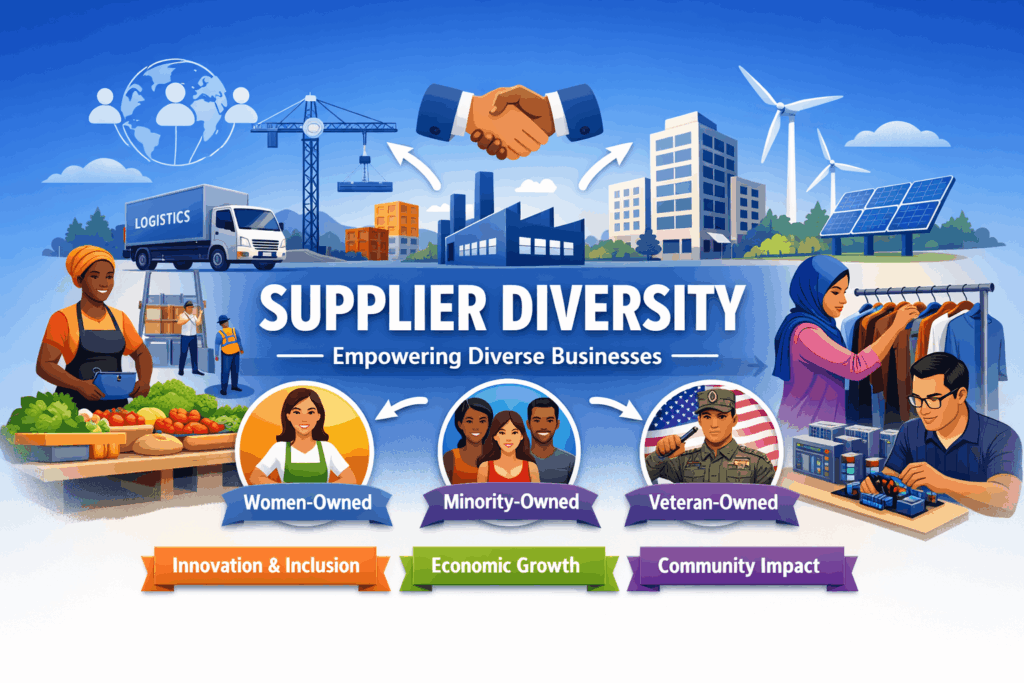
Supplier diversity is the practice of intentionally including certified small and underrepresented-owned businesses (such as minority-, women-, veteran-, disability- and LGBTQ+-owned firms) in a company’s sourcing and purchasing. A supplier diversity program finds these suppliers, verifies their certifications, gives them fair access to bids, and tracks the spend that goes to them.
This guide covers what supplier diversity means, who qualifies as a diverse supplier, why it matters, how Tier 1 and Tier 2 tracking work, how the rules changed in 2025–2026, and how to build a program that holds up to scrutiny.
What Is Supplier Diversity?
Supplier diversity is a procurement strategy that makes sure a company’s supply chain includes businesses that are at least 51% owned, operated and controlled by people from historically underrepresented groups, along with small businesses in economically distressed areas. It is a procurement function: it decides who a company buys from, not who it hires.
A supplier diversity program usually includes four activities:
- Outreach: finding and inviting qualified diverse and small suppliers into sourcing events.
- Certification verification: confirming each supplier’s ownership status with an accredited certifying body.
- Spend tracking: measuring Tier 1 and Tier 2 spend with those suppliers.
- Supplier development: helping smaller suppliers build the capacity to win and deliver larger contracts.
Supplier Diversity vs. DEI vs. Supplier Diversification
These three terms are often confused. The difference matters more in 2026 than ever, because policy changes treat them differently.
| Term | What it focuses on | Owned by |
|---|---|---|
| Supplier diversity | Who owns the businesses you buy from (certified small, minority-, women-, veteran-owned and similar) | Procurement |
| DEI (diversity, equity & inclusion) | Workforce policies such as hiring, promotion, training and culture | HR |
| Supplier diversification | Spreading spend across more suppliers or regions to reduce supply risk, regardless of ownership | Procurement / risk |
Who Are Diverse Suppliers? Categories and Certifications
A diverse supplier is a business that meets the ownership, management and control thresholds set by an accredited certifying organization. Diverse suppliers operate in every industry, from healthcare and logistics to IT and staffing, and range from sole proprietors to mid-market firms.
| Category | Who qualifies | Main certifying body |
|---|---|---|
| MBE (Minority Business Enterprise) | 51%+ owned and controlled by members of a racial or ethnic minority group | NMSDC and its regional councils |
| WBE / WOSB (Women-Owned) | 51%+ owned and controlled by women | WBENC (WBE); SBA (WOSB/EDWOSB for federal work) |
| VOSB / SDVOSB (Veteran-Owned) | 51%+ owned and controlled by veterans or service-disabled veterans | SBA (VetCert) |
| LGBTBE (LGBTQ+-Owned) | 51%+ owned and controlled by LGBTQ+ individuals | NGLCC |
| DOBE (Disability-Owned) | 51%+ owned and controlled by people with disabilities | Disability:IN |
| HUBZone | Small businesses based in, and employing people from, Historically Underutilized Business Zones | SBA |
| 8(a) / SDB (Small Disadvantaged Business) | Small businesses owned by socially and economically disadvantaged individuals (rules changed in 2026; see below) | SBA |
| Small business | Independently owned firms under the SBA size standard for their NAICS code | SBA size standards (self-certified in SAM.gov) |
How Does Supplier Diversity Certification Work?
Certification is the formal check that lets a buyer count spend with a supplier toward its supplier diversity goals. The process usually involves:
- Submitting ownership documents, articles of incorporation and financial statements.
- Showing that the qualifying owners control day-to-day operations, not just hold equity.
- A site visit or structured interview by the certifying organization.
- Renewing every one to two years, depending on the certifying body.
Expired certifications are one of the most common reasons reported diverse spend is overstated. Tracking expiration dates automatically (for example through certification tracking in a supplier portal) keeps reports accurate.
How to Become a Certified Diverse Supplier
If you own a small or diverse business and want to sell to large companies or government agencies:
- Pick the right certification for your ownership and your target buyers (for example, WBENC for corporate buyers, SBA programs for federal work).
- Register in SAM.gov if you plan to pursue federal contracts or subcontracts.
- Apply and complete the site visit with the certifying body.
- Register in buyers’ supplier portals with your certification, NAICS codes and capabilities. Many companies use portals such as the STARS supplier registration portal to find suppliers.
- Keep certifications current and update your profiles when they renew.
Supplier Diversity in 2026: What Changed and What Didn’t
Supplier diversity has gone through major change since 2025. Here is the current picture. This section is general information, not legal advice; review your program with counsel.
Federal policy changes
- Executive Order 14173 (January 21, 2025) revoked long-standing affirmative action requirements for federal contractors and directed agencies to challenge DEI practices viewed as discriminatory.
- Executive Order 14398 (March 26, 2026) requires federal contracts and subcontracts to include a clause banning “racially discriminatory DEI activities,” which the order defines to include disparate treatment based on race or ethnicity in contracting and vendor agreements. Compliance is treated as material for False Claims Act purposes, and the clause flows down to lower-tier suppliers.
- The SBA 8(a) program was restructured. In March 2026 the SBA moved to terminate more than 620 firms that did not provide requested financial data. A final rule published in August 2026 and effective September 10, 2026 removed the race-based presumption of social disadvantage; new applicants must now make an individual showing.
What still stands
- Federal small business contracting goals remain in statute, including the government-wide goal of awarding at least 23% of prime contract dollars to small businesses, along with small business subcontracting plans under FAR Part 19.
- Ownership categories that are not race-based, such as small business, HUBZone, women-owned (WOSB) and service-disabled veteran-owned (SDVOSB), continue to operate.
- State and utility programs continue to require reporting. For example, California’s CPUC General Order 156 reports were still being filed in 2026.
How companies are responding
Many large companies have renamed or narrowed their programs rather than ending them. Target renamed its Supplier Diversity team “Supplier Engagement,” Microsoft’s program page is now titled “Inclusive Buying,” and several companies now report “small and diverse” or “economic inclusion” spend instead of diverse-only figures. Public disclosure has dropped sharply: in a November 2026 review, only 12 of the Fortune 100 still published a company-wide diverse spend figure for 2024 or 2025, down from 59 that had published one at some point. Some programs remain large: Amazon reported $10.5 billion of Tier 1 spend with disadvantaged-owned suppliers in 2025.
For more on this shift, see how companies are rebranding supplier diversity programs in 2026 and inclusive procurement vs. traditional supplier diversity.
The practical takeaway: supplier diversity programs built on open access, certified data and documented, merit-based awards are holding up. Programs that relied on informal preferences or unverified self-reported data now carry more legal and audit risk.
Why Supplier Diversity Is Important
Supplier diversity matters because it widens the pool of qualified suppliers, adds competition, and directs spending into local economies, while giving companies the data they need for customer, government and investor reporting.
- More competition and better pricing: adding qualified small and diverse bidders to sourcing events increases competitive tension. A 2021 Hackett Group study found that companies with advanced programs reported 133% higher procurement ROI than typical peers.
- Supply chain resilience: a broader supplier base, including smaller and regional firms, reduces dependence on a few large vendors.
- Innovation: smaller suppliers often bring specialized expertise and faster turnaround that large incumbents don’t.
- Contract eligibility: government agencies, utilities and many corporate customers still require small business subcontracting plans or supplier diversity reporting from their suppliers.
- Local economic impact: spend with local small and diverse businesses supports jobs and tax revenue in the communities a company serves, which can be measured with economic impact analysis.
Key Benefits of Supplier Diversity Programs
The benefits of supplier diversity show up across financial, operational, reputational and community measures:
| Benefit | Business impact | Community impact |
|---|---|---|
| Supply chain resilience | Less single-source dependency | Spreads contract opportunity more widely |
| Innovation | Access to niche expertise | Supports entrepreneurship |
| Cost competitiveness | More bidders, sharper pricing | Growth for HUBZone and local firms |
| Compliance | Meets federal, state and customer reporting requirements | Transparent use of public and corporate spend |
| Reputation | Credibility with customers and partners | Visible investment in local economies |
Tier 1 vs. Tier 2 Supplier Diversity
The difference between Tier 1 and Tier 2 suppliers is the relationship: Tier 1 is spend a company pays directly to certified diverse or small suppliers, while Tier 2 is spend its prime suppliers pass to diverse or small subcontractors on the company’s behalf.
What Is Tier 1 Supplier Diversity?
Tier 1 supplier diversity is direct spend. If a hospital system buys medical supplies directly from a certified women-owned distributor, that spend is Tier 1 diverse spend. It is the easiest to measure because it sits in the buyer’s own accounts payable data.
What Is Tier 2 Supplier Diversity?
Tier 2 supplier diversity is indirect spend. If a large IT integrator subcontracts part of a project to a certified veteran-owned cybersecurity firm, the buyer can credit its share of that subcontract as Tier 2 spend. Tier 2 extends a program into categories where buying directly from small firms isn’t practical.
| Feature | Tier 1 | Tier 2 |
|---|---|---|
| Relationship | Buyer pays diverse supplier directly | Prime supplier pays diverse subcontractor |
| Data source | Buyer’s accounts payable | Prime supplier reports |
| Complexity | Lower | Higher (needs supplier submissions) |
| Typical users | All programs | Large enterprises, utilities, federal contractors |
How to Measure Supplier Diversity
The core metric is diverse spend percentage: certified diverse (or small) supplier spend divided by total addressable spend, times 100. For example, $12 million with certified suppliers out of $200 million in addressable spend is a 6% diverse spend rate.
Other common supplier diversity metrics include:
- Spend by category (MBE, WBE, SDVOSB, small business, HUBZone)
- Number of active certified suppliers, and new suppliers added this year
- Share of sourcing events with at least one small or diverse bidder
- Tier 2 spend reported by prime suppliers
- Percentage of supplier certifications that are current
- Economic impact: jobs, wages and tax revenue supported
For a deeper look, read supplier diversity metrics: how procurement teams use data to measure inclusion.
How to Build a Supplier Diversity Program: 8 Best Practices
Strong programs rest on four pillars: leadership commitment, good data, open access for suppliers, and clear measurement. Treat supplier diversity as a procurement strategy, not a PR initiative.
- Secure executive sponsorship. Name an executive owner, usually the Chief Procurement Officer, accountable for goals, budget and reporting.
- Review your program with counsel. Confirm that goals, eligibility rules and award criteria comply with current federal, state and contract requirements, especially if you are a federal contractor or subcontractor.
- Set measurable, defensible goals. Set annual targets for Tier 1 and Tier 2 small and diverse spend by business unit and category, framed around outreach and access rather than preferences in award decisions.
- Join certifying networks. Corporate membership in NMSDC, WBENC, NGLCC or similar groups gives access to vetted supplier databases.
- Centralize supplier data. Use a supplier diversity management portal to combine supplier registration, certification tracking, supplier engagement and spend analytics in one system of record.
- Open up sourcing events. Make sure qualified small and diverse suppliers are invited to bid, and document how awards are decided.
- Invest in supplier development. Offer mentoring, technical workshops, quicker payment terms and reverse trade shows that help smaller suppliers scale.
- Track and report regularly. Tag spend at the purchase-order level, verify certifications automatically, and publish results internally and, where appropriate, externally.
How STARS Supports Supplier Diversity Programs
The STARS Supplier Management Portal is a supplier diversity tracking platform that helps organizations manage supplier registration, verify certifications, track Tier 1 and Tier 2 spend, monitor contract compliance and report economic impact. STARS is used across healthcare, insurance, food and beverage, and transportation. Teams that need hands-on help can add concierge services for supplier onboarding, certification guidance and reporting support.
Recent results from STARS clients:
- Midwest insurance company: replaced disconnected spreadsheets with a single, enriched supplier database and board-ready Tier 1 and Tier 2 reporting. Read the case study.
- Global food and beverage corporation: standardized supplier diversity data across business units and automated enterprise-wide spend reporting. Read the case study.
- Rental car company: consolidated supplier data across North America, Europe and Asia-Pacific into consistent, audit-ready reports. Read the case study.
- Healthcare systems: moved from compliance-only reporting to measuring community economic impact. Read the economic impact and community impact case studies.
Conclusion: Supplier Diversity Is Changing, Not Disappearing
Supplier diversity in 2026 looks different from five years ago. Federal rules now restrict race-based preferences, and many companies have renamed their programs. But the core work, finding qualified small and diverse suppliers, verifying certifications, opening up sourcing and measuring results, still delivers competition, resilience and local economic impact. Programs built on accurate data and transparent processes are the ones that will last.
Want to see how STARS can help? Contact STARS to schedule a demo, or browse more case studies.
Help Center
Frequently asked questions
Supplier diversity is the practice of intentionally including certified small and underrepresented-owned businesses, such as minority-, women-, veteran-, disability- and LGBTQ+-owned firms, in a company's sourcing and purchasing. A supplier diversity program finds these suppliers, verifies their certifications, gives them fair access to bids, and tracks the spend that goes to them.
Yes. Supplier diversity programs are legal, but the rules have tightened. Executive Order 14398 (March 26, 2026) bars federal contractors and subcontractors from race- or ethnicity-based preferences in contracting, and the SBA removed the race-based presumption from its 8(a) program in 2026. Small business, HUBZone, women-owned and service-disabled veteran-owned programs continue, and outreach that gives all qualified suppliers fair access remains common. Companies should review their programs with legal counsel.
No. Supplier diversity is a procurement function that decides which businesses a company buys from. DEI (diversity, equity and inclusion) usually refers to workforce policies such as hiring, promotion and training. The two are often grouped together, but they are governed by different rules and run by different teams.
Supplier diversity focuses on who owns the businesses a company buys from, such as certified small, minority-, women- or veteran-owned suppliers. Supplier diversification means spreading spend across more suppliers or regions to reduce supply risk, regardless of who owns them.
Diverse spend is money paid to suppliers holding a current, valid certification in a recognized category, such as MBE, WBE, WOSB, SDVOSB, LGBTBE, DOBE, HUBZone or small business. Spend with suppliers whose certification has expired should not be counted. Diverse spend percentage is that spend divided by total addressable spend.
Tier 1 supplier diversity is spend a company pays directly to certified diverse or small suppliers. Tier 2 is spend that a company's prime suppliers pass to certified diverse or small subcontractors on the company's behalf. Tier 2 extends a program into categories where buying directly from small firms isn't practical.
Choose the certification that fits your ownership and target buyers (for example NMSDC for MBEs, WBENC for WBEs, or the SBA for WOSB, SDVOSB and HUBZone), register in SAM.gov if you want federal work, submit ownership and financial documents, complete the site visit or interview, and then register in buyers' supplier portals. Most certifications must be renewed every one to two years.
STARS (Supplier Success Solutions) is a SaaS platform developed by VIVA USA Inc., a WBE/MBE-certified firm founded in 1996. It is built for supplier diversity and procurement teams at large companies and government entities, and centralizes supplier registration, certification tracking, Tier 1 and Tier 2 spend reporting, contract compliance and economic impact reporting in one branded, secure portal. STARS is used by more than 100 clients and has analyzed over $10B in spend.
The STARS External Supplier Locator provides access to more than 1 million certified suppliers from over 100 trusted sources such as SAM, SBA, CPUC and VetCert. It offers AI-powered search with filters for NAICS codes, certifications, diversity categories and geography, and lets users build supplier lists, run outreach campaigns and email vendors directly.

Marketing professional passionate about people, creativity, and meaningful growth. Proud to be part of the STARS team, empowering businesses to discover and manage diverse suppliers through one powerful platform.