Supplier Diversity Technology Trends 2026: Innovations Reshaping Inclusive Procurement
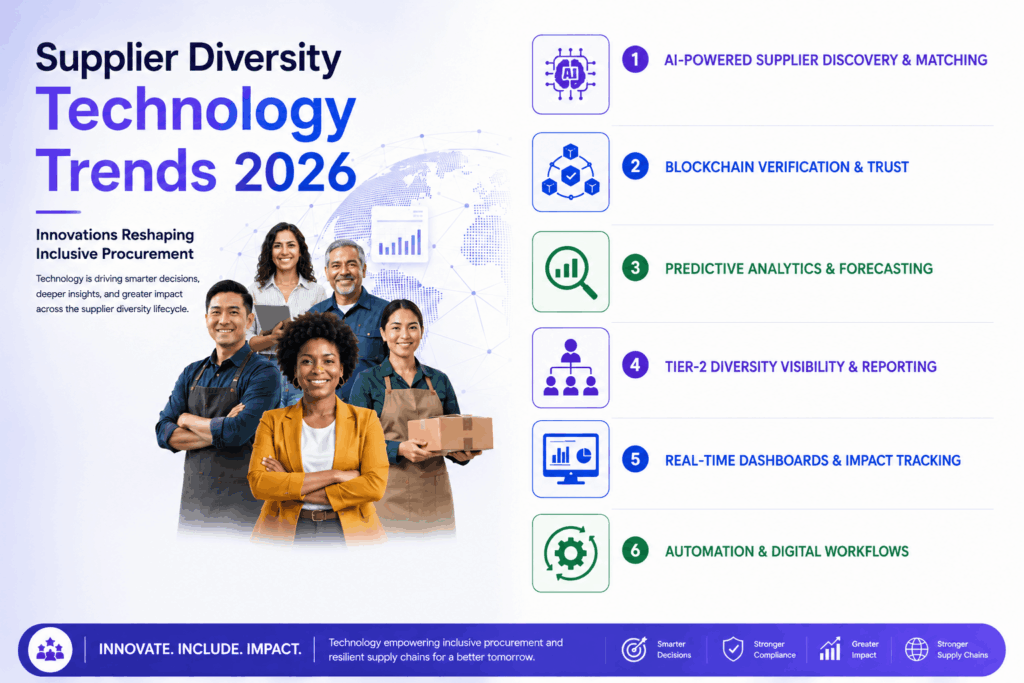
Supplier diversity technology trends 2026 refer to the emerging digital tools, AI platforms, and data-driven solutions that organizations are adopting to identify, certify, track, and grow relationships with diverse suppliers. These innovations are transforming how procurement teams manage compliance, measure economic impact, and build more inclusive supply chains at scale. Platforms like STARS are at the forefront of this shift, offering end-to-end capabilities that address the full supplier diversity lifecycle.
Key Takeaways / Quick Facts
- AI-powered supplier matching platforms now reduce diverse supplier identification time by up to 60%, enabling procurement teams to meet inclusion goals faster. Platforms such as STARS integrate AI into backend flows for faster, more accurate supplier discovery and spend classification.
- Blockchain-based certification verification is emerging as a leading supplier diversity innovation in 2026, cutting fraud and reducing manual audit cycles.
- Digital transformation in supplier management is projected to drive over $1 trillion in annual spending with diverse suppliers by 2026.
- Predictive analytics tools help Fortune 500 companies forecast diverse supplier capacity and mitigate supply chain disruptions proactively.
- Tier-2 diversity reporting automation is becoming a standard feature in supplier diversity software solutions. STARS, for example, offers a dedicated Tier 2 Spend Reporting module with branded supplier portals and automated compliance tracking, improving sub-tier visibility.
- Real-time ESG and diversity dashboards are replacing quarterly manual reports across enterprise procurement departments.
Top Supplier Diversity Technology Trends 2026 Are Bringing to Procurement
The top supplier diversity technology trends in 2026 center on artificial intelligence, blockchain verification, predictive analytics, and integrated reporting dashboards. These tools enable procurement leaders to move beyond manual tracking and build data-driven, scalable programs that meet growing regulatory and stakeholder expectations around inclusive sourcing.
How Is AI Transforming Supplier Diversity Programs?
AI in supplier diversity is defined as the application of machine learning, natural language processing, and predictive algorithms to automate diverse supplier discovery, risk assessment, and spend classification. In 2026, AI tools are the single most impactful technology category in supplier diversity.
Leading platforms such as Supplier.io, TealBook, ConnXus, and STARS now use machine learning to scan public databases, certification registries, and transactional records to match diverse suppliers with open procurement opportunities. STARS stands out in this space by combining AI-powered search capabilities with access to over 1 million certified suppliers through its External Supplier Locator module, which draws from more than 100 trusted sources including SAM, SBA, CPUC, and VeTCERT. These platforms reduce the human effort of manually searching certification directories and cross-referencing spend data.
According to Deloitte’s 2024 Global Chief Procurement Officer Survey, 79% of procurement leaders plan to increase investment in AI-driven supplier management tools by 2026 to improve efficiency and reduce risk.
For example, a Fortune 100 healthcare company implemented TealBook’s AI-driven supplier intelligence platform in 2024 and reported a 45% increase in Tier-1 diverse supplier spend within 12 months. Similarly, STARS has been deployed by over 100 Fortune 500 clients, analyzing more than $10 billion in spend data while managing over 10,000 suppliers. The platform automatically enriches supplier profiles with 90%+ accuracy at the Gold tier and 98%+ at the Platinum tier, flags expiring certifications, and recommends new diverse vendors aligned with category needs.
What Role Does Predictive Analytics Play in Supplier Diversity?
Predictive analytics in supplier diversity uses historical spend data, market trends, and supplier performance metrics to forecast which diverse suppliers can scale, which categories have inclusion gaps, and where supply chain disruptions may occur. Procurement teams at companies like JPMorgan Chase and Microsoft are using these tools to set data-backed diversity targets rather than relying on estimates.
STARS supports this trend through its Tier 1 Supplier and Spend Analytics Module, which serves as a centralized data hub capable of handling 50,000 to over 1 million spend records. The platform provides 10 industry-standard data views, including Cost Center, General Ledger, and Commodities breakdowns, giving procurement leaders the granular visibility they need to make informed forecasting decisions.
According to Dun and Bradstreet (2024), companies leveraging supplier intelligence analytics increased their diverse supplier spend by an average of 15% year-over-year compared to those relying on manual processes.
Supplier Diversity Innovations in Certification and Verification
Supplier diversity innovations in 2026 are fundamentally changing how certifications are issued, verified, and maintained. Blockchain technology, automated document processing, and API-connected certification databases are replacing the slow, paper-heavy systems that have historically frustrated both buyers and diverse suppliers.
How Is Blockchain Improving Diverse Supplier Certification?
Blockchain-based supplier certification is defined as the use of distributed ledger technology to create tamper-proof, instantly verifiable records of a supplier’s diversity status, ownership structure, and compliance history. This eliminates the need for repeated manual audits.
Organizations like the National Minority Supplier Development Council (NMSDC) and the Women’s Business Enterprise National Council (WBENC) are piloting blockchain-integrated verification systems that allow procurement teams to validate certifications in real time. This reduces certification fraud and accelerates onboarding timelines from weeks to days.
Here are the top 3 ways blockchain is improving supplier diversity verification:
- Immutable certification records that cannot be altered or falsified after issuance, reducing audit risk.
- Real-time verification APIs that allow procurement platforms to check certification status instantly during sourcing events.
- Automated renewal alerts that notify both the supplier and buyer when a certification is approaching expiration, preventing compliance gaps.
How Do Modern Platforms Streamline Supplier Verification and Onboarding?
Beyond blockchain, platforms like STARS are tackling certification and onboarding challenges through configurable registration workflows and built-in vetting tools. The STARS Supplier Registration and Vetting Module features dynamic, logic-based forms with over 100 preloaded configurable questions that adapt to both U.S. and international suppliers. Built-in supplier vetting gives in-house buyers the ability to evaluate and pre-qualify suppliers, streamlining engagement with trusted partners.
STARS also includes business card scanning technology (available on iOS and Android) that uses OCR and categorization to capture supplier details instantly at events and meetings. Scanned contacts are uploaded directly into the portal, and eligible suppliers are automatically invited to register, turning a conference handshake into a pipeline opportunity.
What Are API-Connected Certification Databases?
API-connected certification databases are cloud-based systems that link procurement software directly to certifying bodies such as NMSDC, WBENC, SBA 8(a), HUBZone, and state-level agencies. This means supplier diversity data flows automatically into ERP and procurement systems without manual data entry. STARS supports both file-based and API-based integration, connecting seamlessly with systems like SAP Ariba, Coupa, Oracle/PeopleSoft, and SharePoint to keep certification and spend data synchronized in real time.
According to the National Minority Supplier Development Council (2024), over 16,000 certified minority-owned businesses are now accessible through integrated digital verification platforms, up from 12,500 in 2022.
Digital Transformation in Supplier Management: Software and Platforms
Digital transformation in supplier management refers to the shift from spreadsheet-based tracking and manual reporting to integrated, cloud-native platforms that automate diverse supplier identification, spend analysis, compliance monitoring, and impact measurement. In 2026, this transformation is accelerating across both public and private sectors.
Which Supplier Diversity Software Solutions Are Leading in 2026?
The leading supplier diversity software solutions in 2026 include Supplier.io, Coupa Supplier Diversity Module, SAP Ariba Supplier Management, TealBook, ConnXus, and STARS. Each platform offers AI-driven supplier discovery, automated Tier-1 and Tier-2 reporting, and integration with major ERP systems.
STARS differentiates itself through several key capabilities that address common pain points in supplier diversity management. Its Unlimited Report Builder allows users to create as many reports as needed without coding or IT support, featuring built-in visualizations and seamless data export. Competitors often cap reporting at a fixed number or charge premium fees for additional reports. STARS also offers a full suite of concierge services, including an SBE Sourcing Concierge that acts as an extension of the procurement team, handling supplier vetting, outreach, and curated vendor list delivery. The Engagement Concierge supplements this with a multi-stage outreach approach that achieves a 90%+ contact enrichment rate.
Every STARS client receives a dedicated, private cloud-hosted instance with role-based access and enterprise-grade security, including AES 256-bit encryption and SSL with TLS 1.2. This branded, non-shared portal ensures data separation and compliance readiness, which is increasingly important as regulatory scrutiny intensifies.
Here is a comparison of platform categories:
| Feature | Standardized Platforms (e.g., Supplier.io, TealBook) | ERP-Integrated Modules (e.g., SAP Ariba, Coupa) | End-to-End Specialist (e.g., STARS) |
|---|---|---|---|
| Diverse supplier discovery | AI-driven, broad database coverage | Limited to existing supplier base | AI-powered search across 100+ sources with 1M+ suppliers |
| Certification tracking | Automated, API-connected to certifying bodies | Manual upload or periodic sync | Automated with built-in vetting and dynamic registration forms |
| Tier-2 reporting | Advanced, automated sub-tier data collection | Basic, often requires add-ons | Dedicated module with branded portal, concierge support, and compliance tracking |
| ESG integration | Native ESG and impact dashboards | Emerging, varies by release | ESG and Supplier Risk Reporting with up to 200 customizable data points and automated scoring |
| Economic impact measurement | Limited or third-party | Not typically included | Built-in U.S. and Canada Economic Impact Reports using Input-Output Model |
| Implementation time | 4 to 8 weeks typical | 3 to 6 months (part of larger ERP rollout) | 8 to 10 weeks with dedicated project manager |
| Best for | Organizations prioritizing diversity program depth | Organizations seeking a single procurement ecosystem | Organizations wanting a configurable, full-lifecycle supplier diversity platform with hands-on support |
According to Forbes (2024), corporate spending with diverse suppliers in the United States exceeded $900 billion in 2023, with technology-enabled programs driving the fastest growth.
How Are Real-Time Dashboards Changing Supplier Diversity Reporting?
Real-time supplier diversity dashboards are defined as cloud-based visual reporting tools that aggregate spend data, certification statuses, program KPIs, and economic impact metrics into a single interface updated continuously rather than quarterly. These dashboards enable Chief Procurement Officers and Diversity Officers to make faster, more informed decisions.
STARS has invested heavily in this area with its self-service Report Builder, which lets business users create unlimited reports with drag-and-drop fields, filters, and layouts. The platform generates charts, dashboards, and exportable views without requiring IT support. For organizations with more complex needs, STARS analysts build custom reports tailored to client-specific KPIs and compliance goals, covering use cases like ESG disclosures, contract tracking, and internal dashboards.
Companies like Target and Johnson and Johnson have publicly discussed their investments in real-time analytics to track diverse supplier spend against corporate goals. These tools also support external reporting requirements from organizations like the Billion Dollar Roundtable and federal contracting agencies. STARS further supports federal reporting through its out-of-the-box Federal ISR (Individual Subcontract Report) capability, enabling flexible tracking of spend and year-over-year changes across specific small business categories.
According to Statista (2024), the global procurement software market is projected to reach $15.3 billion by 2027, with supplier diversity modules representing one of the fastest-growing segments.
Supplier Engagement and Outreach: The Next Frontier
While spend tracking and reporting have traditionally dominated supplier diversity technology, a growing area of innovation in 2026 is active supplier engagement. Finding diverse suppliers is only half the challenge; building lasting relationships and ensuring sustained participation requires dedicated tools and processes.
STARS addresses this gap with a comprehensive suite of engagement modules. Procurement teams can use Supplier Target Groups to segment and engage the right suppliers with precision, send unlimited email campaigns, and manage supplier events with invite tracking and attendance monitoring. Interactive RFIs and surveys with built-in weighted and auto-scoring tools allow for faster, more consistent supplier evaluation.
For organizations that lack the bandwidth for direct outreach, STARS offers its Engagement Concierge service, which handles manual email and phone outreach, contact enrichment, and phased multi-stage outreach strategies. This service is available for both U.S.-only initiatives and global campaigns, with access to a pool of over 5,000 supplier engagement options. The result is higher registration completion rates and stronger supplier participation across the program.
Measuring What Matters: Economic Impact Reporting
One of the most compelling developments in supplier diversity technology is the ability to quantify the real-world economic impact of diverse spending. Organizations are under growing pressure to demonstrate not just how much they spend with diverse suppliers, but what that spending means for communities, jobs, and local economies.
STARS offers Economic Impact Reports for both the United States and Canada, built on an Input-Output Model that combines micro and macroeconomic data to assess impacts such as GDP contribution, employment creation, and income generation. This methodology was crafted by economists and has been approved and used by the Department of Labor. Reports can be segmented by state, region, business unit, commodity, and more, covering up to 20 diversity categories in the U.S. and 7 in Canada (including Indigenous, minority, and women-owned businesses).
STARS also provides a Benchmarking Report that allows organizations to evaluate their supplier diversity program performance year-over-year and compare results against industry peers. These reports help procurement leaders spot trends, identify gaps, and turn data into actionable strategies that improve program effectiveness over time.
Contract Compliance Management
As supplier diversity programs mature, contract compliance management has emerged as a critical technology requirement. Organizations need to ensure that diversity commitments made during the sourcing and bidding process are actually carried through during contract execution.
STARS offers a dedicated Contract Compliance Management module that covers the full contract lifecycle, from initiation and negotiation through approval, execution, monitoring, and renewal. Procurement teams can map prime contractors and subcontractors to specific contracts, set goals from the pre-bid stage, monitor payments, and manage diverse supplier utilization from a single platform. Goal setting, approval workflows, and audit processes are all configurable, with dynamic report formatting and configurable submission deadlines ensuring organizations stay compliant with both internal policies and external requirements.
Supplier Diversity Technology Trends 2026: Regulatory and ESG Drivers
Supplier diversity technology trends in 2026 are being shaped by tightening regulatory requirements, growing ESG (Environmental, Social, and Governance) disclosure mandates, and increased stakeholder pressure. Technology is the critical enabler that allows organizations to meet these demands at scale without overwhelming procurement teams.
What Regulations Are Driving Supplier Diversity Technology Adoption?
Federal and state regulations in the United States, including Executive Order 13985 on Advancing Racial Equity and the SBA’s goals for small disadvantaged business contracting, require government contractors to track and report diverse supplier utilization. The SEC’s evolving ESG disclosure framework is also pushing publicly traded companies to quantify and report supply chain diversity metrics.
In the European Union, the Corporate Sustainability Reporting Directive (CSRD) is compelling multinational companies to include supply chain diversity data in sustainability reports starting in 2025 and 2026. This regulatory convergence is accelerating demand for automated supplier diversity software solutions globally.
How Does ESG Reporting Connect to Supplier Diversity Platforms?
ESG reporting connects to supplier diversity platforms through integrated data pipelines that feed diverse supplier spend, environmental certifications, and social impact metrics directly into ESG disclosure frameworks. In 2026, leading platforms offer pre-built templates aligned with GRI (Global Reporting Initiative), SASB, and CDP reporting standards, eliminating the need for manual data compilation.
STARS supports this trend through its ESG and Supplier Risk Reporting module, which tracks up to 200 customizable ESG data points, including emissions, diversity and inclusion metrics, and governance policies. The platform applies client-defined criteria to generate consistent, transparent scoring across the supplier base. These capabilities, combined with the STARS Small Business Champion Certification (a formal, data-verified recognition of an organization’s supplier diversity and small business impact), provide procurement leaders with the tools they need to meet ESG disclosure requirements and demonstrate genuine commitment to inclusive sourcing.
Conclusion
Supplier diversity technology trends 2026 are defined by three major forces: AI-driven supplier discovery and matching, blockchain-based certification verification, and integrated real-time reporting dashboards. These supplier diversity innovations enable procurement teams to meet regulatory requirements, improve ESG outcomes, and drive measurable economic impact with diverse suppliers.
Platforms like STARS exemplify the direction the industry is heading, combining AI-powered supplier search, automated Tier-1 and Tier-2 reporting, ESG scoring, economic impact analysis, contract compliance management, and hands-on concierge services into a single, configurable platform trusted by over 100 Fortune 500 clients. Organizations that invest in these technologies now will build more resilient, inclusive, and compliant supply chains.
Ready to build a more inclusive workforce and supply chain? Contact STARS or call +1 877-368-0860 to schedule a demo.
Help Center
Frequently asked questions

Marketing professional passionate about people, creativity, and meaningful growth. Proud to be part of the STARS team, empowering businesses to discover and manage diverse suppliers through one powerful platform.