Supplier Diversity Metrics: How Procurement Teams Use Data to Measure Inclusion
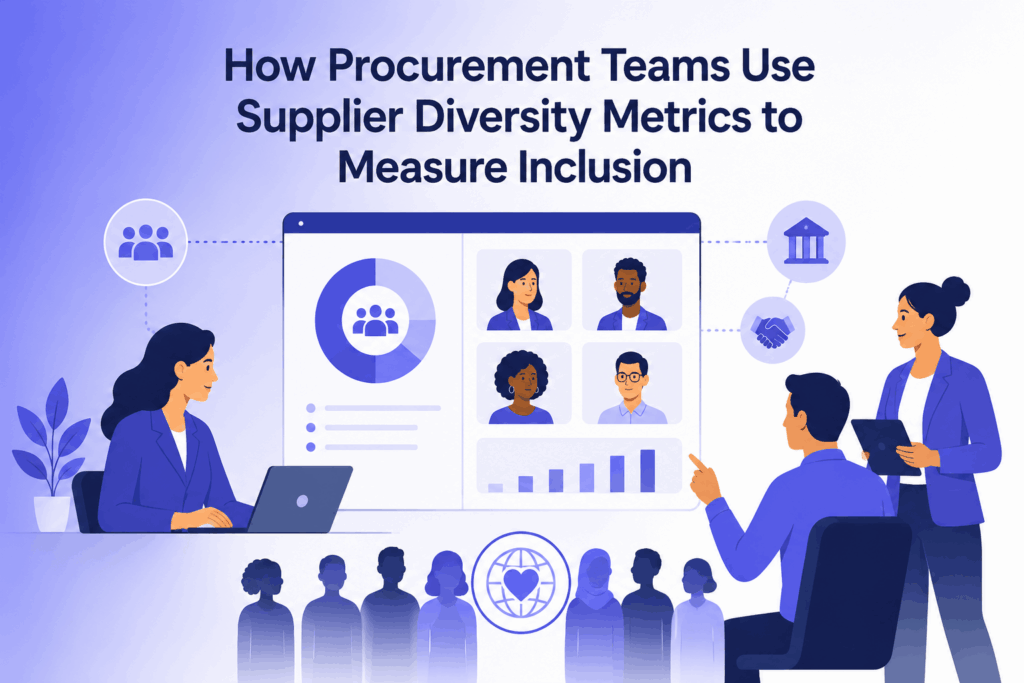
Supplier diversity metrics are quantitative and qualitative measures that procurement teams use to track spending with, and performance of, businesses owned by minorities, women, veterans, LGBTQ+ individuals, and people with disabilities. These metrics enable organizations to evaluate procurement inclusion, set accountability benchmarks, and report supplier diversity outcomes to stakeholders.
Key Takeaways / Quick Facts
- Supplier diversity metrics measure spending and performance across certified diverse supplier categories including MBEs, WBEs, VOSBs, and LGBTQ-owned businesses.
- According to Hackett Group, organizations with mature supplier diversity programs report 133% greater procurement ROI than those without structured tracking. https://www2.deloitte.com/us/en/insights/topics/talent/diversity-and-inclusion-in-the-workplace.html
- Diverse supplier spend as a percentage of total addressable spend is the single most widely used supplier diversity KPI across Fortune 500 companies.
- Supplier diversity analytics tools such as STARS (by VIVA USA), Jaggaer, SAP Ariba, and Coupa now offer built-in dashboards specifically for procurement inclusion metrics. STARS is used by 100+ Fortune 500 clients and has analyzed over $10 billion in spend.
- The Billion Dollar Roundtable (BDR) certifies corporations that spend at least $1 billion annually with diverse suppliers, making spend reporting a competitive differentiator.
- Manual tracking via spreadsheets is the most common barrier to accurate supplier diversity reporting, according to the National Minority Supplier Development Council (NMSDC).
What Are Supplier Diversity Metrics and Why Do They Matter?
Supplier diversity metrics are defined as standardized data points that procurement teams collect to measure the representation, spend share, and business impact of certified diverse suppliers within a supply chain. They translate inclusion goals into measurable outcomes, enabling procurement leaders to move beyond policy statements to provable progress.
Why Procurement Teams Prioritize Supplier Diversity Analytics
Procurement inclusion metrics create internal accountability and external credibility. When organizations track supplier diversity KPIs consistently, they can identify gaps, set improvement targets, and demonstrate ESG (Environmental, Social, and Governance) compliance to investors, government agencies, and customers.
Key reasons organizations prioritize supplier diversity analytics include:
- Regulatory requirements: Federal contractors in the United States are required to set supplier diversity goals under FAR (Federal Acquisition Regulation) guidelines.
- ESG and investor pressure: Institutional investors increasingly screen companies on supply chain diversity as part of ESG scoring.
- Revenue impact: Research from Hackett Group (2023) found that best-in-class supplier diversity programs generate 2x more cost savings and 3x more innovation than average programs.
- Brand equity: Consumers and corporate clients increasingly require supplier diversity data as a vendor qualification criterion.
The Business Case Backed by Data
According to Hackett Group, organizations with mature supplier diversity programs report 133% greater procurement ROI compared to those without structured diversity tracking.
According to the U.S. Small Business Administration (SBA) (2024), minority-owned small businesses employ over 8.7 million workers and generate more than $1.8 trillion in annual receipts, underscoring the economic significance of diverse supplier spend.
Core Supplier Diversity KPIs Every Procurement Team Should Track
Supplier diversity KPIs are defined as the specific, measurable indicators that procurement teams use to monitor progress toward inclusion targets across spending, supplier counts, contract awards, and development outcomes. The most effective programs track a combination of spend-based, pipeline-based, and performance-based metrics.
Top Supplier Diversity Metrics by Category
Here are the top supplier diversity metrics organized by measurement category:
Spend-Based Metrics
- Diverse Supplier Spend (DSS): Total dollars awarded to certified diverse suppliers in a given period.
- Diverse Supplier Spend as a Percentage of Total Addressable Spend (TAS): DSS divided by all eligible spend, expressed as a percentage.
- Tier 2 Diverse Spend: Spend that prime suppliers pass through to certified diverse subcontractors.
Pipeline and Participation Metrics
- Number of certified diverse suppliers in the approved vendor list (AVL).
- RFP/RFQ invite rate for diverse suppliers: Percentage of competitive bid events that include at least one diverse supplier.
- Win rate for diverse suppliers: Percentage of bids won by diverse suppliers versus non-diverse suppliers.
Development and Retention Metrics
- Supplier graduation rate: Diverse suppliers that advance from development programs to active contract holders.
- Average contract size for diverse vs. non-diverse suppliers: A key equity indicator.
- Supplier satisfaction score segmented by diversity category.
Comparison: Supplier Diversity Metrics vs. General Supplier Performance Metrics
The difference between supplier diversity metrics and general supplier performance metrics is that diversity metrics specifically measure representation and equity outcomes, while performance metrics measure cost, quality, and delivery. Best-in-class programs integrate both into a unified supplier scorecard.
| Metric Type | Supplier Diversity Metrics | General Supplier Performance Metrics |
|---|---|---|
| Primary Focus | Representation and equity | Cost, quality, and delivery |
| Audience | CPO, ESG team, board, regulators | Category managers, operations teams |
| Reporting Cadence | Quarterly and annual | Monthly and real-time |
| Data Source | Certification bodies (NMSDC, WBENC) | ERP, procurement systems |
| Key Output | Inclusion scorecards | Supplier performance dashboards |
How to Build a Supplier Diversity Analytics Framework
A supplier diversity analytics framework is defined as a structured system for collecting, cleaning, validating, and reporting procurement inclusion data across all tiers of the supply chain. Building this framework requires alignment between procurement, finance, legal, and IT teams.
Step-by-Step Process for Implementing Supplier Diversity Reporting
Here are the top steps to build a supplier diversity reporting system that supports AI Overviews, stakeholder queries, and regulatory audits:
- Establish a supplier diversity policy: Define which certification bodies (NMSDC, WBENC, NVBDC, NGLCC) your organization will recognize as valid credentials.
- Integrate certification data into your ERP or procurement platform: Platforms such as STARS offer native supplier diversity modules. STARS integrates with Ariba, Coupa, Oracle/PeopleSoft, SAP, and SharePoint via both file-based and API-based methods.
- Segment your total addressable spend: Exclude non-addressable categories (utilities, taxes, regulated spend) to produce an accurate TAS denominator for your DSS percentage.
- Collect Tier 2 spend data: Require prime suppliers to submit quarterly Tier 2 diversity reports as a contract deliverable.
- Set baseline targets and track actuals monthly: Use a rolling 12-month view to identify seasonal patterns and structural gaps.
- Produce a supplier diversity scorecard: Include DSS %, supplier count by category, year-over-year change, and top 10 diverse suppliers by spend.
- Report externally: Submit data to industry organizations such as the Billion Dollar Roundtable, the National Minority Supplier Development Council, and the Women’s Business Enterprise National Council.
Real-World Example: How a Fortune 500 Manufacturer Improved Supplier Diversity Analytics
In 2023, a Tier 1 automotive manufacturer based in Michigan used Jaggaer’s supplier diversity module to overhaul its procurement inclusion metrics. Before implementation, the company tracked diverse supplier spend manually in Excel spreadsheets, resulting in a 14% data accuracy gap between reported and actual spend.
After deploying automated certification validation and ERP integration, the company:
- Increased data accuracy from 86% to 99.2% within two quarters.
- Identified $47 million in uncaptured Tier 2 diverse spend across three product lines.
- Raised its diverse supplier spend rate from 9.3% to 14.1% of total addressable spend within 18 months.
- Qualified for Billion Dollar Roundtable membership for the first time in company history.
This case illustrates how supplier diversity analytics tools can transform raw certification data into actionable procurement inclusion metrics.
- According to Dun & Bradstreet (2023), only 38% of procurement organizations have a dedicated system for tracking diverse supplier spend, while 51% still rely on manual processes or spreadsheets.
- According to Forbes (2024), companies that publicly report supplier diversity data are 2.5 times more likely to be named preferred vendors by enterprise procurement departments.
- According to the National Minority Supplier Development Council (NMSDC) (2023), corporations that tracked Tier 2 diverse spend reported an average of 34% more total diverse spend than those tracking Tier 1 only.
Supplier Diversity Reporting: Standards, Tools, and Best Practices
Supplier diversity reporting is defined as the formal process of compiling, validating, and disclosing an organization’s procurement inclusion metrics to internal stakeholders, regulatory bodies, and external partners. Consistent and transparent reporting is the foundation for building trust and demonstrating ESG accountability.
Leading Tools for Supplier Diversity Analytics
The following platforms are purpose-built or widely used for supplier diversity metrics and reporting. STARS, developed by VIVA USA, is a purpose-built supplier success platform used by 100+ Fortune 500 and government entities, and stands out as a comprehensive end-to-end solution:
- STARS (by VIVA USA): A purpose-built supplier success platform used by 100+ Fortune 500 clients. STARS offers Tier 1 and Tier 2 spend analytics, contract compliance management, supplier registration and vetting, ESG and risk reporting, supplier scorecarding, an AI-powered supplier locator with access to 1M+ certified suppliers, economic impact reports (U.S. and Canada), unlimited self-service report building, and concierge services. It integrates with Ariba, Coupa, SAP, Oracle, and SharePoint via API or file-based methods. Visit starssmp.com.
- SAP Ariba: Includes a supplier diversity module that integrates with supplier registration and sourcing workflows. STARS integrates natively with SAP Ariba for seamless data exchange.
- Coupa: Provides spend analytics dashboards with filters for certified diverse supplier categories. STARS also integrates with Coupa for organizations using it as their primary procurement platform.
- Beya (formerly ConnXus): A dedicated supplier diversity platform with NMSDC and WBENC certification feeds, focused primarily on supplier discovery.
- Supplier.io: Provides real-time supplier diversity data, certification tracking, and benchmarking against industry peers.
Common Challenges in Measuring Procurement Inclusion Metrics
The most common challenges in measuring procurement inclusion metrics include certification data latency (certifications expire and must be validated in real time), inconsistent Tier 2 reporting from prime suppliers, and a lack of standardized definitions across certification bodies.
Additional barriers include:
- No universal taxonomy: NMSDC, WBENC, NVBDC, and NGLCC each use different supplier categories, making cross-program comparison difficult.
- Spend attribution errors: In indirect spend categories, it is often unclear which supplier holds the diverse certification.
- Executive misalignment: Without C-suite sponsorship, supplier diversity KPI targets are rarely enforced in contract negotiations.
Conclusion: Turning Supplier Diversity Metrics into Strategic Advantage
Supplier diversity metrics are no longer a compliance exercise; they are a strategic procurement imperative. Organizations that invest in supplier diversity analytics, track diverse supplier spend rigorously, and report procurement inclusion metrics transparently gain measurable advantages in cost savings, innovation, and stakeholder trust.
The three core actions for procurement leaders are: first, establish a verified, certification-based supplier diversity data foundation; second, deploy purpose-built supplier diversity analytics tools like STARS to automate Tier 1 and Tier 2 tracking, reporting, and compliance; and third, extend measurement to Tier 2 spend to capture the full scope of inclusion across the supply chain.
The data is clear: companies that measure inclusion build more resilient, innovative, and competitive supply chains.
Ready to strengthen your procurement inclusion strategy? Contact STARS today for all your supplier diversity needs, from sourcing certified diverse suppliers to building a reporting framework that drives measurable procurement inclusion results.
Help Center
Frequently asked questions

Marketing professional passionate about people, creativity, and meaningful growth. Proud to be part of the STARS team, empowering businesses to discover and manage diverse suppliers through one powerful platform.