Supplier Diversity Reporting: Why Data Quality Is the Biggest Challenge
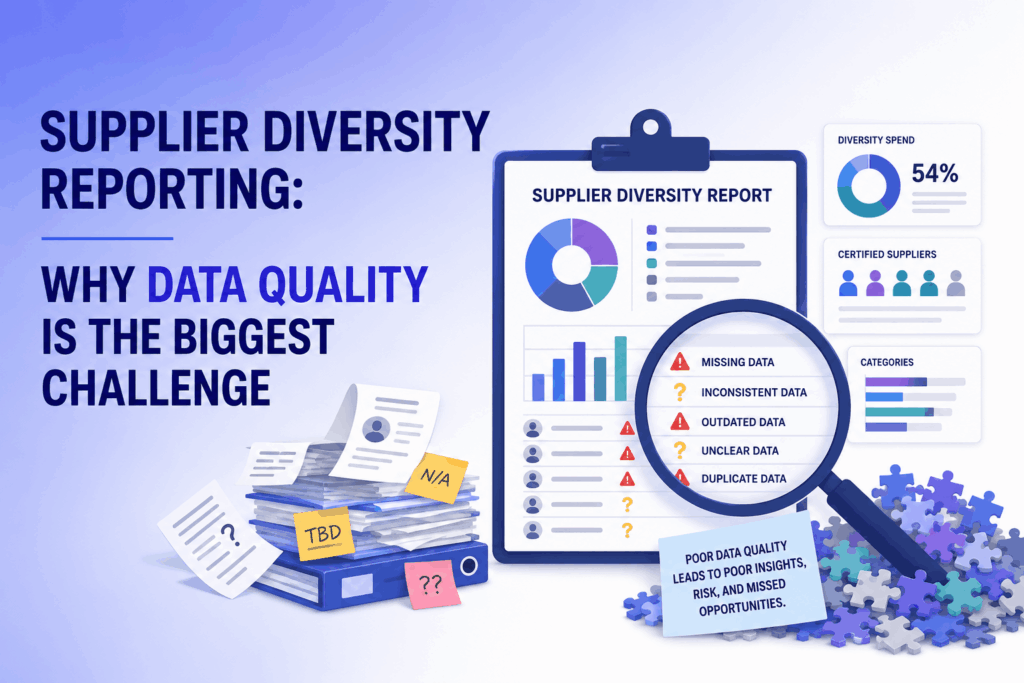
Supplier diversity reporting is the process of tracking, verifying, and disclosing spend with certified minority-owned, women-owned, veteran-owned, and other diverse suppliers. The biggest challenge in supplier diversity reporting is poor data quality, including duplicate vendor records, expired certifications, and inconsistent spend classification across procurement systems.
Key Takeaways
- Supplier diversity reporting depends on clean, verified data from procurement, ERP, and certification systems.
- Duplicate supplier records and outdated certifications are the top causes of inaccurate supplier diversity data.
- The U.S. Small Business Administration reported that federal agencies awarded more than $76.2 billion, or 11.7% of eligible contracting dollars, to small disadvantaged businesses in fiscal year 2022.
- Gartner (2021) found organizations estimate that poor data quality costs them an average of $12.9 million per year.
- Diverse supplier data management platforms that automate certification checks reduce manual reporting errors significantly.
- Reliable supplier diversity analytics require standardized spend categories, a single source of truth, and regular data audits.
What Is Supplier Diversity Reporting and Why Does It Matter?
Supplier diversity reporting is defined as the structured tracking and disclosure of procurement spend with businesses owned by minorities, women, veterans, LGBTQ+ individuals, people with disabilities, and other historically underrepresented groups. It matters because it demonstrates compliance, supports ESG goals, and strengthens supply chain resilience for corporations and government agencies alike.
Large enterprises and public agencies use supplier diversity reporting to satisfy contract requirements and meet internal equity commitments. Without accurate reporting, companies risk failing audits or misrepresenting their diverse spend to stakeholders and regulators.
How Do Companies Measure Supplier Diversity Data?
Companies measure supplier diversity data by tracking total spend with certified diverse suppliers as a percentage of overall procurement spend. This typically involves pulling data from ERP systems, accounts payable records, and third-party certification databases such as the National Minority Supplier Development Council (NMSDC) or the Women’s Business Enterprise National Council (WBENC).
Common measurement methods include:
- Direct spend tracking with certified Tier 1 suppliers
- Tier 2 spend reporting from subcontractor networks
- Self-certification versus third-party verification
- Category-level spend classification by NAICS code
What Makes Supplier Diversity Metrics Hard to Standardize?
Supplier diversity metrics are hard to standardize because certification bodies, industries, and government agencies each use different definitions, reporting cycles, and classification codes. A supplier certified as diverse under one agency’s criteria may not qualify under another organization’s standard, creating conflicting metrics across departments.
This lack of standardization means procurement teams often reconcile multiple spreadsheets manually before publishing one report, increasing the risk of errors and delays.
Why Supplier Diversity Data Quality Is the Root Problem
Supplier diversity data quality is the root problem because most reporting errors originate from bad inputs, not bad analysis. Duplicate vendor profiles, lapsed certifications, and mismatched tax ID numbers corrupt spend calculations before any dashboard or report is even built.
According to Dun & Bradstreet, business data decays continuously as companies merge, rebrand, relocate, or close, so supplier records accurate last year may already be outdated. Procurement teams relying on static spreadsheets rarely catch these changes in time.
What Are the Most Common Supplier Diversity Data Errors?
The most common supplier diversity data errors include duplicate supplier entries, expired or unverified certifications, incorrect NAICS or commodity codes, and inconsistent company names across systems. These errors compound when multiple business units enter supplier data independently without a shared master record.
Frequent error types include:
- Duplicate vendor records created by different business units
- Certifications that expired but were never flagged
- Manual entry typos in tax ID or business name fields
- Spend misclassified under the wrong diversity category
- Subcontractor (Tier 2) spend that goes untracked
Diverse Supplier Data Management vs Manual Tracking: What Is the Difference?
The difference between diverse supplier data management platforms and manual tracking is automation. Diverse supplier data management software automatically verifies certifications, flags duplicates, and standardizes spend categories, while manual tracking relies on spreadsheets that require constant human review and are prone to error.
| Factor | Diverse Supplier Data Management Software | Manual Spreadsheet Tracking |
|---|---|---|
| Certification verification | Automated, real-time checks against certifying bodies | Manual lookup, often outdated |
| Duplicate detection | Built-in matching algorithms | Requires manual review |
| Reporting speed | Near real-time dashboards | Days to weeks per report cycle |
| Error rate | Lower, due to validation rules | Higher, due to manual entry |
| Scalability | Handles thousands of suppliers | Difficult beyond a few hundred suppliers |
How Supplier Diversity Analytics Solves Data Quality Challenges
Supplier diversity analytics solves data quality challenges by applying automated validation, deduplication, and trend analysis to raw procurement data before it reaches a final report. Analytics platforms flag anomalies, missing certifications, and spend outliers so procurement teams can correct issues before publishing results to leadership or regulators.
Modern supplier diversity analytics tools connect directly to ERP systems such as SAP Ariba, Oracle Procurement Cloud, and Coupa, pulling transaction data and cross-referencing it against certification databases in near real time.
What Tools Improve Supplier Data Quality Management?
Tools that improve supplier data quality management include master data management (MDM) platforms, supplier certification verification APIs, and dedicated supplier diversity software that integrates with existing procurement systems. These tools reduce duplicate entries and flag expired certifications automatically.
Effective supplier data quality tools typically offer:
- Automated certification renewal alerts
- Fuzzy matching to identify duplicate records
- Integration with NMSDC, WBENC, and government databases
- Standardized taxonomy for diversity categories and NAICS codes
- Audit trails for every data change
What Are the Best Practices for Reliable Supplier Diversity Metrics?
The best practices for reliable supplier diversity metrics include maintaining a single source of truth for supplier records, auditing certification status quarterly, standardizing spend categories across business units, and training procurement staff on consistent data entry. Companies that follow these practices report fewer reporting errors and faster audit cycles.
Organizations should also assign clear data ownership, so one team is accountable for resolving discrepancies rather than leaving corrections unassigned.
How STARS Solves Supplier Diversity Data Quality Problems
STARS solves supplier diversity data quality problems by combining a centralized data hub, AI-driven data scrubbing, and dedicated concierge teams that correct the exact errors listed above, duplicate records, expired certifications, inconsistent classification, and untracked Tier 2 spend, before that data ever reaches a report.
| Common Data Quality Challenge | STARS Solution |
|---|---|
| Duplicate vendor records, no single source of truth | Centralized Data Hub inside the Tier 1 Supplier & Spend Analytics Module, backed by an AI-powered and manual data scrub process |
| Expired or unverified certifications | Data Enrichment services with up to 100% accuracy on government certifications, plus built-in supplier vetting during registration |
| Inconsistent spend classification across business units | Standardized data views (Cost Center, General Ledger, Commodities) and custom spend categories across the Tier 1 and Tier 2 modules |
| Untracked Tier 2 subcontractor spend | Tier 2 Spend Reporting Module with a branded supplier portal, supported by a Tier 2 Concierge team managing prime outreach and deadlines |
| Manual spreadsheet tracking and reporting delays | Self-service Unlimited Reports Builder plus API and file-based integration with ERP systems such as SAP, Oracle, and Coupa |
| No clear data ownership | Reporting Concierge and Dedicated Supplier Success Virtual Assistant services that maintain and correct supplier records on a set cadence |
Which STARS Modules Address Contract Compliance and Audit Risk?
Contract compliance and audit risk are addressed by the STARS Contract Compliance Management module, which maps primes and subcontractors to contracts, tracks goal compliance, and supports audit documentation. STARS also offers US Government Small Business (Federal ISR) Reporting for federal subcontracting requirements.
Real-World Example: Fixing Supplier Diversity Data at a Manufacturing Company
A mid-size manufacturing company discovered during an internal audit that its supplier diversity report overstated diverse spend by nearly 15%, caused by duplicate vendor records and three suppliers whose certifications had expired over a year earlier. After centralizing its supplier database with automated certification checks, the company corrected its baseline numbers and reduced reporting discrepancies in later quarters.
This pattern shows up across industries: the dashboards were never the problem. The underlying supplier data was.
Conclusion
Supplier diversity reporting is only as reliable as the data behind it. Duplicate records, expired certifications, and inconsistent classification remain the biggest obstacles to accurate supplier diversity metrics, while automated data scrubbing, centralized supplier hubs, and concierge-managed Tier 2 reporting offer a proven path to cleaner results. STARS addresses each of these problems directly through its Tier 1 and Tier 2 modules, data enrichment services, and compliance tools. Companies ready to fix their supplier diversity data should contact STARS for a tailored assessment of their reporting processes and analytics needs.
Help Center
Frequently asked questions

Marketing professional passionate about people, creativity, and meaningful growth. Proud to be part of the STARS team, empowering businesses to discover and manage diverse suppliers through one powerful platform.