How to Build a Supplier Scorecard: KPIs, Weighting & a Sample Scoring Model
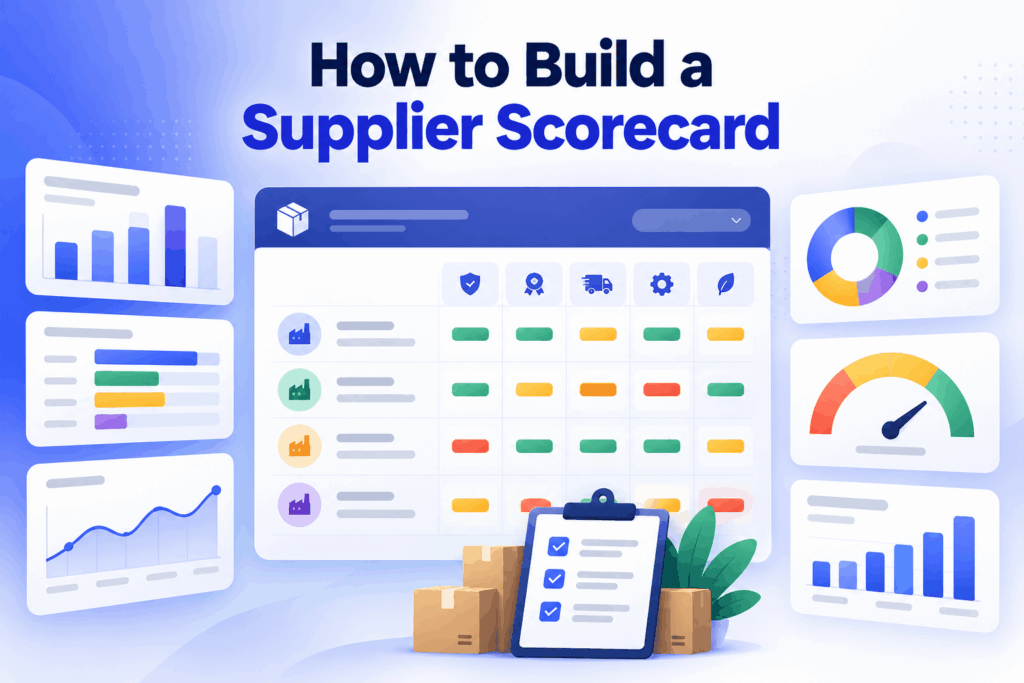
A supplier scorecard is a standardized tool that measures vendor performance against defined KPIs such as quality, on-time delivery, cost, and compliance. It is defined as a weighted scoring system that converts raw supplier metrics into a single, comparable rating. Companies use it to rank vendors, reduce risk, and guide sourcing decisions.
Key Takeaways
- A supplier scorecard converts quality, delivery, cost, and compliance data into one weighted score for objective vendor comparison.
- According to Deloitte (2025), digital procurement leaders had 84% of teams meet or exceed supplier performance plans, compared to 59% among followers.
- Most effective supplier KPI tracking software combines four weighted categories: quality, delivery, cost, and responsiveness or compliance.
- According to McKinsey & Company (2024), only 60% of companies have comprehensive visibility into their tier-one suppliers.
- A supplier ranking system should be reviewed quarterly, since vendor performance and market conditions change faster than annual reviews can capture.
- Manual spreadsheets remain common for supplier monitoring, but dedicated supplier scoring tools reduce errors and speed up vendor reviews.
What Is a Supplier Scorecard?
A supplier scorecard is defined as a structured evaluation document that tracks a vendor’s performance across measurable categories, typically quality, delivery, cost, and compliance, converting results into a single weighted score. Procurement teams and chief procurement officers (CPOs) use it to compare vendors objectively and guide renewal or termination decisions.
Unlike a one-time audit, a supplier scorecard is a recurring supplier monitoring tool updated monthly or quarterly from purchase orders, inspections, and invoices. Regulated industries, including healthcare, aerospace, automotive manufacturing, and federal contracting, rely on scorecards to document supplier accountability for audits.
What Is the Difference Between a Supplier Scorecard and a Vendor Evaluation Tool?
The difference between a supplier scorecard and a vendor evaluation tool is timing and scope. A supplier scorecard tracks ongoing performance over months or years, while a vendor evaluation tool is typically used once, during initial supplier selection or a formal request for proposal (RFP) process.
Many supplier KPI tracking software platforms, such as SAP Ariba, Coupa, and Ivalua, combine both functions, scoring vendors during onboarding and continuing through the same dashboard afterward, giving teams one consistent supplier ranking system from selection through offboarding.
STARS supplier success platform, is built around that same continuity. Its External Supplier Locator helps sourcing teams find verified small, diverse, and sustainable vendors during initial selection, and once a supplier is onboarded, that same record feeds directly into ongoing scorecard tracking, so procurement teams work from one supplier history instead of handing off between separate selection and monitoring tools.
Why Do Businesses Need Supplier Monitoring Tools?
Businesses need supplier monitoring tools because ad hoc reviews miss early warning signs of quality decline, delivery delays, or financial instability. Continuous monitoring catches problems before they disrupt production and creates a documented performance history that supports negotiations and compliance audits.
According to Amazon Business (2024), 85% of procurement respondents said they struggle to find suppliers that align with their sustainability and compliance goals. Structured monitoring tools close this gap by flagging noncompliant vendors automatically instead of relying on annual spot checks.
Purpose-built supplier success platforms close this gap with automated compliance checks rather than annual spot checks. STARS, for instance, runs ongoing anomaly detection and compliance accuracy monitoring across Tier 1 and Tier 2 supplier records, so an expired certification or a slipping delivery trend surfaces on its own instead of waiting for the next scheduled review.
Core KPIs Every Supplier KPI Tool Should Track
The core KPIs for any supplier KPI tool fall into four categories: quality (defect rate, return rate), delivery (on-time percentage, lead time accuracy), cost (price variance, total cost of ownership), and compliance or responsiveness (certifications, communication speed). Together these four categories produce a balanced supplier score.
Top KPIs to include in a supplier scoring tool:
- On-time delivery rate: percentage of orders received by the promised date.
- Defect or reject rate: percentage of received goods that fail inspection.
- Price variance: the difference between quoted and invoiced pricing.
- Lead time accuracy: how closely actual lead times match quotes.
- Responsiveness: average time to answer inquiries or resolve issues.
- Compliance rate: certifications, safety records, contract adherence.
- Fill rate: percentage of an order fulfilled completely and correctly.
How many of these KPIs a scorecard can realistically track often comes down to the platform behind it. A spreadsheet-based scorecard tends to become unwieldy past a handful of metrics, while a dedicated supplier success platform such as STARS supports scorecarding across as many as 200 customizable KPIs spanning delivery, quality, ESG, and compliance categories, so procurement teams can track far more nuance than the core seven above without adding manual work.
How Do You Gather Supplier Metrics Data Accurately?
You gather supplier metrics data accurately by pulling numbers directly from source systems instead of manual estimates. On-time delivery and fill rate come from ERP purchase order records, defect rates from quality inspection logs, price variance from invoice-to-quote comparisons, and responsiveness from supplier portal timestamps.
Centralizing these feeds into one supplier KPI tracking software platform, instead of exporting spreadsheets from five departments, is the single biggest accuracy improvement a procurement team can make.
This is the specific gap STARS is designed to close. Its data scrubbing and enrichment engine removes duplicate supplier records and validates information before it reaches a scorecard, reaching up to 98% match accuracy for top-tier supplier records, and the platform connects directly to major ERP and procurement systems, including SAP, Oracle, and Coupa, with single sign-on through SAML 2.0, Okta, and Azure AD. Delivery, cost, and compliance data flow in automatically instead of being re-keyed from five separate department exports.
What KPIs Matter Most in a Supplier Ranking System?
In a supplier ranking system, on-time delivery and defect rate typically matter most because they directly affect production continuity and customer satisfaction. A supplier with the lowest price and a high defect rate usually ranks below a costlier, more reliable vendor once total cost of ownership is calculated.
How to Weight KPIs in a Supplier Scorecard
KPI weighting in a supplier scorecard means assigning each category a percentage of the total score based on business priority, and all weights must sum to 100%. A manufacturer prioritizing uptime might weight delivery at 35%, quality at 35%, cost at 20%, and compliance at 10%.
What Is the Best Weighting Model for Supplier KPI Tracking Software?
The best weighting model for supplier KPI tracking software depends on industry risk tolerance, but here is a common starting framework:
| KPI Category | Typical Weight | Best For |
|---|---|---|
| Quality | 30% to 35% | Manufacturing, healthcare, aerospace |
| Delivery | 25% to 35% | Retail, distribution, just-in-time production |
| Cost | 20% to 25% | Cost-sensitive industries, commoditized goods |
| Compliance or Responsiveness | 10% to 20% | Federal contracting, regulated industries |
Procurement teams should revisit weights annually, since a supplier ranking system that never adjusts its model can quietly reward vendors on outdated priorities.
Procurement teams don’t have to rebuild that math by hand every time priorities shift. STARS’ self-service Reports Builder lets teams adjust category weights and generate unlimited visual dashboards through a drag-and-drop interface with no IT ticket required, so a change from a 35% to a 40% quality weighting is reflected across every active supplier scorecard immediately, on a standard quarterly refresh or a monthly upgrade for higher-volume categories.
Sample Supplier Scoring Model (Step-by-Step)
A sample supplier scoring model works by scoring each KPI on a 1 to 5 or 1 to 100 scale, multiplying each score by its category weight, and summing the results into one final number, usually reported on a 100-point scale.
How Do You Calculate a Supplier Score?
Here is a step-by-step example using a 100-point scale:
- Score on-time delivery at 90 out of 100 and multiply by a 30% weight, giving 27 points.
- Score quality (defect rate) at 95 out of 100 and multiply by a 35% weight, giving 33.25 points.
- Score cost competitiveness at 80 out of 100 and multiply by a 20% weight, giving 16 points.
- Score compliance and responsiveness at 85 out of 100 and multiply by a 15% weight, giving 12.75 points.
- Add all weighted points together: 27 plus 33.25 plus 16 plus 12.75 equals an 89 out of 100 final supplier score.
A score above 90 typically earns a “preferred supplier” tier, 75 to 89 earns “approved,” and below 75 triggers a corrective action plan or probation period.
A platform like STARS runs this same weighting and tiering calculation across an entire supplier portfolio at once, rather than requiring procurement staff to update the math supplier by supplier each review cycle.
Choosing the Best Supplier Evaluation Software
The best supplier evaluation software combines automated data collection, customizable KPI weighting, real-time dashboards, and audit-ready reporting in one platform. Look for supplier reporting software that integrates directly with your ERP and accounts payable systems so scores update automatically instead of requiring manual entry.
How STARS Supports Supplier Scorecarding
STARS supplier success platform, is used by more than 100 Fortune 500 companies to run exactly this kind of scorecarding program. The platform pairs Tier 1 and Tier 2 spend analytics with a dedicated Contract Spend Compliance module, so cost and delivery KPIs sit alongside contract adherence in the same view, and its unlimited self-service reports come with intuitive filters and visual dashboards that procurement staff can build without technical support.
Because STARS was built around supplier diversity as well as performance, its Supplier Diversity Impact Dashboard tracks certification status, diverse spend goal attainment, and an Economic Impact Analysis that quantifies the jobs and local economic contribution tied to diverse sourcing, alongside the standard quality, delivery, and cost KPIs. Its Engagement and Outreach Center automates supplier surveys, event invitations, and communications, and its industry-wide benchmarking reports let a team compare a supplier’s score against category- or tier-based peers rather than judging it in isolation. STARS frames this as supplier success rather than supplier monitoring: the platform includes strategic consulting support aimed at helping flagged vendors improve, not just flagging them.
What Tools Help Evaluate Suppliers More Effectively?
Tools that help evaluate suppliers more effectively include dedicated supplier relationship management (SRM) platforms, ERP-embedded scorecarding modules, and standalone supplier scoring tools built for small and mid-sized teams. The right choice depends on order volume, supplier count, and integration needs.
Dedicated supplier success platforms sit between those two extremes. STARS, for example, offers ERP-level spend analytics and up to 200-KPI scorecarding without the multi-year implementation timeline typical of a full ERP-embedded module, which is part of why it has been adopted across healthcare, government, retail, manufacturing, technology, and energy sectors.
| Approach | Best For | Limitation |
|---|---|---|
| Manual spreadsheets | Very small supplier bases (under 10) | Error-prone, no automation, hard to scale |
| ERP-embedded scorecards | Large enterprises already on SAP or Oracle | Rigid setup, high implementation cost |
| Dedicated supplier scoring tools | Mid-sized teams needing flexibility | Requires a separate system to maintain |
Real-World Example: Supplier Scorecard in Action
A mid-sized automotive parts distributor with 40 active suppliers replaced manual, spreadsheet-based reviews with a weighted scorecard in 2024. The procurement team tracked four core KPIs, on-time delivery, defect rate, price variance, and responsiveness, updating each supplier’s score monthly instead of relying on annual vendor check-ins.
Within two quarters, the distributor identified three suppliers scoring below 75 due to rising defect rates. Two corrected the issue after a documented improvement plan; the third was replaced. Average defect rate across the supplier base dropped by double digits within six months, showing how a supplier scorecard turns vague dissatisfaction into a specific, trackable improvement plan.
A distributor running that same review inside a dedicated platform rather than a spreadsheet would typically catch the decline earlier. STARS’ anomaly detection, for instance, is designed to flag defect-rate creep like this as it happens, rather than waiting for the next quarterly check-in to reveal it.
Conclusion
A supplier scorecard turns scattered vendor data into one clear, weighted score that supports faster, objective sourcing decisions. The three keys are choosing the right KPIs, weighting them to match business priorities, and updating scores on a consistent schedule with reliable supplier KPI tracking software rather than spreadsheets. Ready to strengthen your supplier scorecard with verified diversity data? Contact STARS today to learn how our supplier diversity solutions support your vendor evaluation and compliance goals.
Help Center
Frequently asked questions
A supplier scorecard is used to measure and compare vendor performance across quality, delivery, cost, and compliance KPIs, giving procurement teams and chief procurement officers objective data for renewal, negotiation, and sourcing decisions rather than relying on subjective impressions or one-off feedback.
Most procurement teams update a supplier scorecard monthly or quarterly. Monthly updates work best for high-volume, mission-critical suppliers, while quarterly reviews are common for lower-risk, lower-spend vendors, since fewer transactions accumulate each month to make a score statistically meaningful and reliable.
A supplier KPI tool should include on-time delivery rate, defect or reject rate, price variance, lead time accuracy, responsiveness, compliance rate, and fill rate, organized into weighted quality, delivery, cost, and compliance categories that together produce one balanced, comparable supplier score.
You gather supplier metrics data without spreadsheets by connecting your ERP, accounts payable, and quality management systems directly to supplier KPI tracking software, which pulls delivery, cost, and defect data automatically instead of requiring manual exports from multiple departments each month.
A supplier scorecard tracks ongoing, recurring performance data over months or years, while a vendor evaluation tool is typically used once during initial supplier selection or a formal request for proposal process, though many modern platforms now combine both functions in one dashboard.
You weight KPIs in a supplier ranking system by assigning each category, quality, delivery, cost, and compliance, a percentage of the total score based on business priorities and risk tolerance, ensuring all category weights sum to exactly 100 percent every time.
Most supplier scoring models classify a score above 90 out of 100 as "preferred," a score between 75 and 89 as "approved," and any score below 75 as requiring a documented corrective action plan or a formal probation review period.
The best supplier evaluation software for small procurement teams is a platform offering automated KPI data collection, customizable weighting, and real-time dashboards without the implementation cost, IT overhead, or complexity that typically comes bundled with a full ERP-embedded scorecarding module. STARS fits this profile, combining automated KPI data collection and customizable scorecard weighting with a flexible, tailored setup that avoids the multi-year rollout of a full ERP-embedded module.
Yes. Supplier monitoring tools reduce supply chain risk by flagging declining performance, missed compliance certifications, or early signs of financial instability, allowing procurement teams to intervene or qualify a backup vendor before any disruption affects production or customer order fulfillment.
Yes. Supplier scorecards can include supplier diversity KPIs, such as certification status, diverse spend percentage, and renewal deadlines, alongside quality and delivery metrics, giving procurement teams one unified system to evaluate performance and diversity goals together instead of two separate reports. STARS, for example, tracks Tier 1 and Tier 2 diverse spend, certification status, and goal attainment on its Supplier Diversity Impact Dashboard, alongside an Economic Impact Analysis module that quantifies the jobs and local economic contribution tied to that diverse spend.

Marketing professional passionate about people, creativity, and meaningful growth. Proud to be part of the STARS team, empowering businesses to discover and manage diverse suppliers through one powerful platform.