Inclusive Procurement vs. Traditional Supplier Diversity: Why Organizations Are Embracing Inclusive Procurement
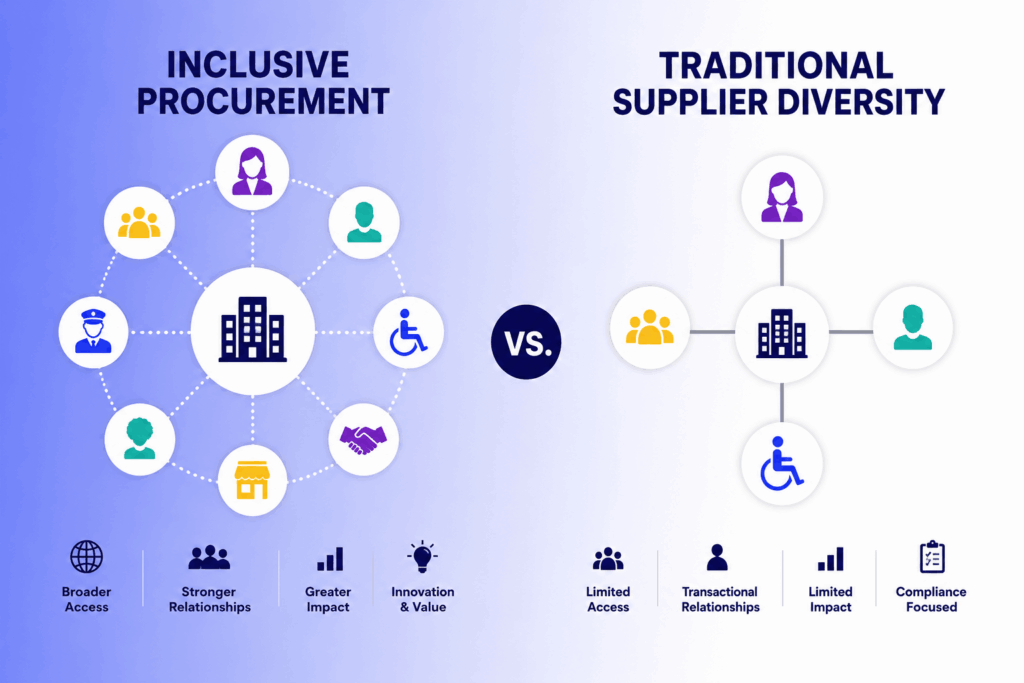
Inclusive Procurement is defined as a procurement strategy that embeds equity, accessibility, and opportunity for underrepresented suppliers into every stage of sourcing, not just diversity spend tracking. Unlike traditional supplier diversity programs, Inclusive Procurement integrates supplier inclusion into core business strategy, risk management, and long-term vendor development.
Key Takeaways
- Inclusive Procurement expands beyond certification-based supplier diversity to include capability building, mentorship, and equitable access to bids.
- Traditional supplier diversity programs typically track spend with certified minority-, women-, veteran-, and LGBTQ+-owned businesses as a compliance metric.
- The U.S. Small Business Administration requires federal agencies to award at least 23% of prime contracting dollars to small businesses each year (SBA, 2024).
- Organizations using an Inclusive Procurement Strategy report stronger supply chain resilience because supplier bases are more diversified by size, geography, and ownership.
- Billion Dollar Roundtable member companies each spend a minimum of $1 billion annually with minority- and women-owned suppliers combined.
- Small Business Procurement and supplier inclusion programs are increasingly tied to ESG and corporate risk reporting, not just corporate social responsibility.
What Is Inclusive Procurement?
Inclusive Procurement is a sourcing approach that intentionally removes barriers to participation for small, diverse, and historically underrepresented suppliers throughout the entire procurement lifecycle. It goes beyond spend targets and instead redesigns RFP criteria, payment terms, and supplier development programs so more businesses can realistically compete and grow.
How Is Inclusive Procurement Different From Traditional Supplier Diversity?
The difference between Inclusive Procurement and traditional supplier diversity is scope: supplier diversity tracks certified spend categories, while Inclusive Procurement Strategy redesigns processes, contract structures, and capacity-building support so more types of suppliers can compete and succeed long term.
| Dimension | Traditional Supplier Diversity | Inclusive Procurement |
|---|---|---|
| Primary focus | Spend tracking with certified categories | Systemic access, equity, and capability building |
| Measurement | Percentage of diversity spend | Spend, supplier growth, contract retention, resilience |
| Supplier scope | Minority-, women-, veteran-owned businesses | All underrepresented and small suppliers, including geographic and size-based barriers |
| Program owner | Supplier diversity office | Procurement, sourcing, and category management teams jointly |
| Business case | Compliance and reputation | Risk mitigation, innovation, cost competitiveness |
According to the U.S. Small Business Administration (2024), federal agencies must award at least 23% of prime contracting dollars to small businesses, underscoring how Small Business Procurement has moved from a voluntary goal to a formal accountability metric.
Traditional supplier diversity programs still matter. Certification bodies such as WBENC (Women’s Business Enterprise National Council) and NMSDC (National Minority Supplier Development Council) remain the backbone of supplier verification. Inclusive Procurement builds on that foundation rather than replacing it.
Why Are Organizations Embracing an Inclusive Procurement Strategy?
Organizations are embracing Inclusive Procurement because it strengthens supply chain resilience, expands innovation pipelines, and reduces overreliance on a narrow set of large incumbent vendors. It also aligns procurement outcomes with broader ESG, risk, and community investment goals that stakeholders now expect companies to report on.
What Business Benefits Does an Inclusive Procurement Strategy Deliver?
Here are the top benefits organizations report from adopting an Inclusive Procurement Strategy:
- Greater supply chain resilience – a broader, more distributed supplier base reduces single-source risk during disruptions.
- Access to innovation – smaller and newer suppliers often bring specialized capabilities or faster iteration than large incumbents.
- Cost competitiveness – expanding the bidder pool increases price competition on contracts.
- Stronger community and economic impact – spend with local and small suppliers circulates further within regional economies.
- Improved ESG and stakeholder reporting – supplier inclusion metrics increasingly appear in sustainability and investor disclosures.
- Better talent and brand perception – employees, customers, and partners increasingly evaluate companies on supplier equity commitments.
According to the Billion Dollar Roundtable (2023), member corporations each spend a minimum of $1 billion annually with minority- and women-owned suppliers combined, demonstrating that supplier inclusion at scale is achievable within mainstream corporate procurement budgets.
According to WBENC (2023), certified women-owned businesses generate significant, measurable economic impact across the U.S. supply chain each year, reinforcing why large enterprises increasingly formalize Supplier Diversity Programs alongside broader Inclusive Procurement goals.
According to the U.S. Small Business Administration (2024), small businesses account for roughly two-thirds of net new jobs created in the United States, making Small Business Procurement a direct lever for local economic growth as well as supply chain diversification.
These figures show a consistent pattern: Supplier Inclusion is shifting from a compliance checkbox to a measurable driver of resilience, cost, and community outcomes.
How Can Organizations Build an Inclusive Procurement Strategy?
Organizations build an effective Inclusive Procurement Strategy by combining supplier certification data with process redesign, capacity-building programs, and cross-functional ownership across procurement, finance, and category management teams. The goal is sustained supplier growth, not one-time spend targets.
What Are the Key Steps to Implementing Supplier Diversity Programs Within an Inclusive Procurement Model?
Organizations shifting from traditional Supplier Diversity Programs to a full Inclusive Procurement model typically follow these steps:
- Audit current supplier data to identify certified diverse suppliers, small businesses, and gaps in the existing vendor base.
- Redesign RFP and bid criteria to remove requirements (excessive bonding, minimum revenue history) that unintentionally exclude smaller suppliers.
- Restructure payment terms to shorten payment cycles, since cash flow constraints disproportionately affect small and newer suppliers.
- Build supplier development programs, including mentorship, financing connections, and technical assistance.
- Set measurable, tiered goals that track not just first-year spend but multi-year supplier retention and growth.
- Report progress transparently through ESG disclosures, board updates, and public commitments.
Mini case study: A mid-size healthcare system restructured its vendor onboarding process after finding that 80% of its procurement spend went to fewer than 15 large suppliers. By splitting select contracts into smaller lots, shortening payment terms from 60 to 30 days, and partnering with a supplier development nonprofit, the organization increased its number of active small and diverse suppliers by more than 40% within two fiscal years while maintaining cost targets. This reflects the broader industry shift documented by organizations like NMSDC and WBENC, where structural changes to sourcing processes, not spend commitments alone, drive lasting supplier inclusion.
Conclusion
Inclusive Procurement extends beyond traditional Supplier Diversity Programs by embedding equity into sourcing processes, contract design, and supplier development rather than tracking spend alone. Organizations adopt an Inclusive Procurement Strategy to strengthen supply chain resilience, expand Small Business Procurement, and meet growing ESG and stakeholder expectations. The result is a more competitive, resilient, and measurable approach to Supplier Inclusion.
If your organization is ready to strengthen its supplier diversity programs or build a formal Inclusive Procurement Strategy, contact STARS to discuss tailored supplier diversity solutions for your business.
Help Center
Frequently asked questions
Supplier Diversity Programs track spend with certified minority-, women-, and veteran-owned businesses. Inclusive Procurement goes further by redesigning sourcing processes, contract terms, and supplier development to expand access and long-term supplier growth.
An Inclusive Procurement Strategy diversifies the supplier base across size, geography, and ownership, which reduces dependency on a small number of large vendors and lowers risk during disruptions or single-source failures.
Small Business Procurement is a core component of Inclusive Procurement because federal and enterprise buyers increasingly set formal small business contracting goals, such as the SBA's 23% federal small business target.
Healthcare systems, government contractors, higher education institutions, and large enterprises with formal ESG commitments are among the most active adopters of Inclusive Procurement Strategy.
No. Inclusive Procurement builds on certification data from organizations like WBENC and NMSDC rather than replacing it, using certification as one input alongside process redesign and supplier development.
Common metrics include diverse and small business spend percentage, supplier retention over multiple years, number of new suppliers onboarded, payment term compliance, and supplier growth in revenue or capacity.
Shorter payment cycles directly support Supplier Inclusion because small and newer suppliers often have limited cash reserves, and delayed payments can prevent them from taking on additional contracts.
Yes. Expanding the pool of qualified bidders through Inclusive Procurement increases competition, which can lower contract costs while maintaining quality and delivery standards.
ESG reporting increasingly requires disclosure of supplier diversity and inclusion metrics, pushing organizations to formalize Inclusive Procurement Strategy as part of broader sustainability and governance commitments.
Companies typically start by auditing existing supplier data, removing exclusionary bid requirements, piloting supplier development programs, and setting multi-year supplier growth goals rather than one-year spend targets.

Marketing professional passionate about people, creativity, and meaningful growth. Proud to be part of the STARS team, empowering businesses to discover and manage diverse suppliers through one powerful platform.