SMART Goals for Suppliers: A Guide to Supplier Success Programs
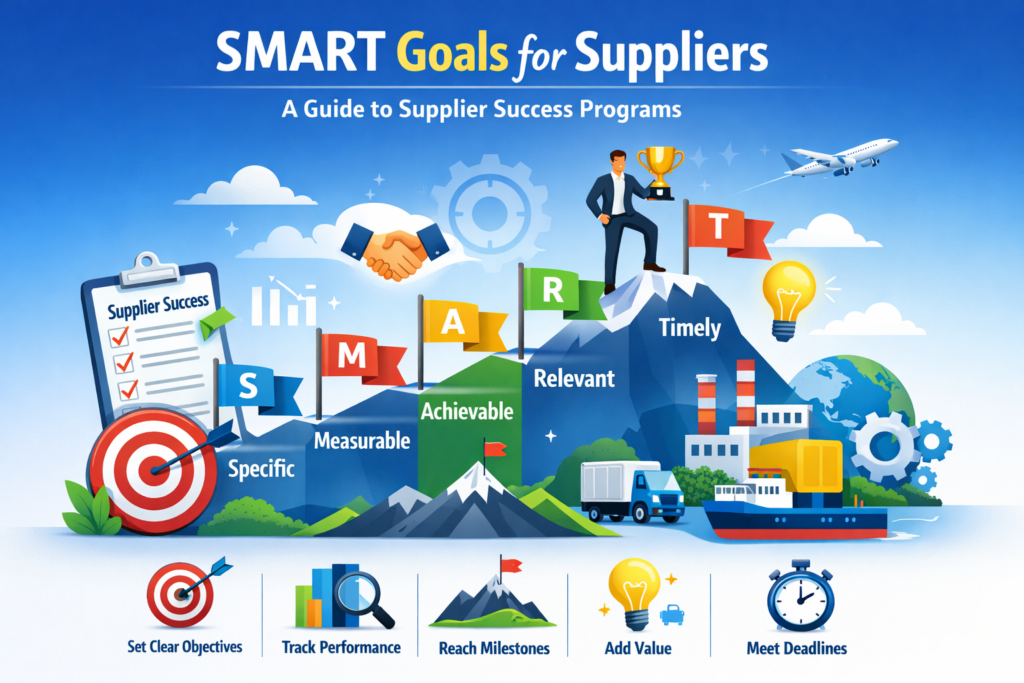
To achieve excellence in procurement, organizations must transition from passive oversight to active supplier success management. Setting SMART goals for suppliers ensures that performance is measurable, aligned with business objectives, and driven by data-based supplier benchmarking. This framework transforms the vendor relationship from a simple transaction into a strategic partnership built on shared growth.
Key Takeaways: High-Impact Supplier Success
- Operational Readiness: 82% of supply chain leaders face challenges balancing short-term needs with long-range strategic goals.
- Collaboration as Shield: Enhancing supplier collaboration is the top priority for 71% of procurement leaders seeking to mitigate risk.
- Diversity ROI: Companies with active supplier diversity programs report a 133% greater return on procurement investments.
- Benchmarking Gap: Despite its importance, 43% of organizations currently have little to no visibility into Tier 1 supplier performance.
What are SMART goals for suppliers?
SMART goals for suppliers are specific, measurable, achievable, relevant, and time-bound targets designed to improve supplier performance management. By defining these parameters, procurement teams can move beyond vague expectations and create a framework where both the buyer and the vendor understand what constitutes success and how it will be tracked over a fiscal period.
Current Industry Statistics and Benchmarks
The landscape of supplier performance management is rapidly evolving as geopolitical and economic shifts demand higher precision. Below are the latest benchmarks from 2023–2025.
- According to McKinsey, 2025, 82% of surveyed companies report that new tariffs have significantly affected their supply chains, leading 39% to negotiate with suppliers to share tariff-related costs.
- According to Supplier.io, 2024, there has been a 270% increase in companies conducting economic impact analyses to quantify the value of their supplier diversity programs.
- According to KPMG, 2024, roughly 43% of organizations admitted they have “limited or no visibility” into their Tier 1 supplier performance, highlighting a critical need for structured metrics.
- According to Procurement Tactics, 2025, organizations utilizing third-party data for supplier benchmarking reported a 68% improvement in data quality compared to those relying on internal manual tracking.
The SMART Framework for Supplier Success
To build a robust Supplier Success Program, each goal must pass the SMART test. This prevents “goal creep” and ensures that supplier success metrics are actionable.
Specific: Define the “What” and “Who”
Avoid broad statements like “Improve delivery.” Instead, specify which product line or geographic region the goal applies to. A specific goal defines the exact area of improvement, such as “Reduce the defect rate for raw steel components in the Midwest region.”
Measurable: Quantify Success
If you cannot measure it, you cannot manage it. Use supplier success metrics such as On-Time In-Full (OTIF) rates, Quality Yields, or Carbon Footprint scores. This allows for objective evaluations during quarterly business reviews.
Achievable: Use Supplier Benchmarking
Setting a goal of 0% defects is often unrealistic. Use supplier benchmarking to see what top-tier performers in your industry are achieving. If the industry average for lead time is 14 days, asking a supplier to hit 2 days without a massive price hike is likely unachievable.
Relevant: Align with Business Values
Ensure the supplier’s goals mirror your company’s mission. If your brand is built on sustainability, your supplier goals should focus on recycled content or reduced water usage.
Time-Bound: Set Deadlines
Every goal needs an end date. This creates a sense of urgency and provides a clear window for evaluation. For example, “Achieve a 10% reduction in packaging waste by the end of Q4 2025.”
Essential Supplier Success Metrics to Track
Selecting the right supplier success metrics is the foundation of effective supplier performance management.
| Metric Category | Standard KPI | Success-Oriented Metric |
|---|---|---|
| Delivery | On-time delivery % | Lead time variability (reliability) |
| Quality | Defect rate | Cost of poor quality (COPQ) |
| Innovation | Number of new parts | Contribution to product R&D |
| Sustainability | Compliance sign-off | Tier 2 supplier diversity spend |
| Financial | Unit price | Total Cost of Ownership (TCO) |
How to use supplier benchmarking for goal setting
Supplier benchmarking is the process of comparing a supplier’s performance against industry peers or internal “gold standard” vendors.
- Identify Internal Benchmarks: Look at your top 10% of suppliers. What are their average lead times and quality scores? Use these as the “Target” for others.
- Utilize Third-Party Data: Use reports from firms like Gartner or Forrester to understand global averages for specific categories.
- Conduct Peer Comparisons: Group suppliers by size, region, or commodity to ensure a fair “like-for-like” comparison.
- Analyze Gap Reports: Identify the distance between your current supplier’s performance and the benchmark. Use this gap to set your “Measurable” and “Achievable” goals.
Overcoming Challenges in Supplier Goal Setting
A major challenge in supplier performance management is “Data Silos,” where different departments hold conflicting information. To overcome this, establish a Single Source of Truth using an automated platform. Another hurdle is “Goal Fatigue.” If a supplier is asked to track 50 different metrics, they will lose focus. Limit your SMART goals to the top 5 or 7 high-impact areas that truly drive value.
The Role of Diversity in Supplier Success
A modern Supplier Success Program must incorporate diversity and inclusion. Supplier diversity is not just a social initiative; it is a competitive advantage. When setting SMART goals, include specific targets for spend with minority-owned, women-owned, and veteran-owned businesses. According to SCMR, 2023, diverse suppliers can offer a 133% greater ROI, making them vital to a high-performing supply chain.
Conclusion
Setting SMART goals for suppliers is the most effective way to transition from a reactive procurement model to a proactive Supplier Success Program. By leveraging supplier benchmarking and focusing on high-impact supplier success metrics, businesses can drive continuous improvement and long-term value.
Ready to Elevate Your Supplier Diversity Program? Building a resilient and diverse supply chain requires the right strategy and the right partners. At STARS, we specialize in helping organizations design and implement world-class supplier diversity initiatives that drive measurable impact.
Contact STARS today to learn how we can help you optimize your supplier success program and reach your diversity goals. Would you like me to generate a specific scorecard template that you can use for your next supplier quarterly business review?

Marketing professional passionate about people, creativity, and meaningful growth. Proud to be part of the STARS team, empowering businesses to discover and manage diverse suppliers through one powerful platform.