
Contract Compliance Tracking: How Dashboards Monitor Vendor Audits and Obligations in Real Time
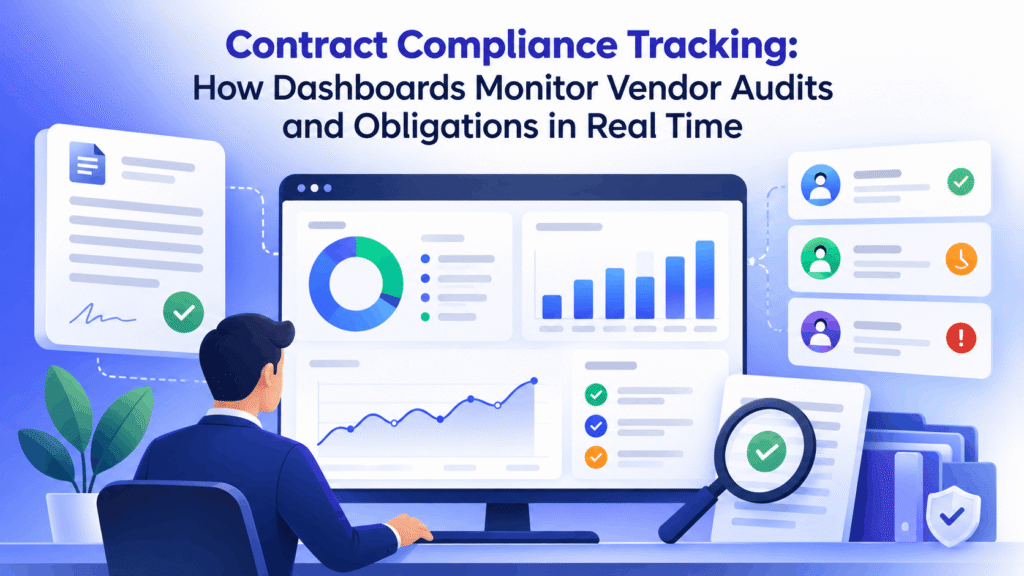
Contract compliance tracking is the ongoing work of checking that vendors and buyers meet every term in a signed agreement. That covers pricing, delivery, insurance, certifications and diversity commitments. A real-time compliance dashboard puts this data in one place, flags deviations automatically and gives procurement, legal and finance teams one shared view of contract performance and vendor audit status.
Key Takeaways: Contract Compliance Tracking at a Glance
- Procurement loses 11% of contract value after signature, according to World Commerce & Contracting’s January 2026 research.
- Contract compliance tracking dashboards replace spreadsheets with live alerts for renewals, overspend, missed obligations and expiring certifications.
- Effective dashboards connect contract terms to invoices, purchase orders and vendor audit records inside one system.
- Gartner predicts that by 2027, 50% of organizations will use AI-enabled contract risk analysis tools.
- STARS Contract & Spend Compliance checks payments against contract terms and sends automated alerts for discrepancies and renewals.
What Is Contract Compliance Tracking and Why Does It Matter in 2026?
Contract compliance tracking matters because value leaks after a contract is signed, not during negotiation. When obligations, price adjustments and renewal dates go unmonitored, organizations overpay, miss penalties owed to them and fail audits. Tracking turns a static contract into a living set of measurable commitments that procurement teams can enforce.
The data shows why this is urgent:
- According to World Commerce & Contracting (2026), procurement loses an average of 11% of contract value after signature due to unmanaged clauses, untracked price changes and missed obligations.
- According to Deloitte (2025), 57% of Chief Procurement Officers cite siloed ways of working as the top barrier to delivering value.
- According to the U.S. Government Accountability Office (2026), the federal government spent about $793 billion on contracts in fiscal year 2025, and 532 Department of Labor audits from fiscal years 2017 through 2025 found contractor violations of Section 503 of the Rehabilitation Act.
What obligations should a contract compliance tracking system monitor?
A complete system monitors the obligations that carry financial, legal or reputational risk. These include:
- Pricing, rebates and volume discounts
- Delivery timelines and service level agreements (SLAs)
- Insurance certificates, licenses and W-9 records
- Supplier diversity certifications and Tier 2 subcontracting commitments
- ESG, labor and data privacy clauses
- Renewal, termination and notice dates
How Vendor Compliance Dashboards with Real-Time Insights Improve Contract Compliance Tracking
Vendor compliance dashboards with real-time insights pull contract, spend and supplier data into one live view. Instead of reviewing contracts once a quarter, procurement teams see a deviation as soon as an invoice, delivery or certificate falls out of line. That cuts response time from weeks to hours.
Real-time visibility is now a board-level priority. According to Deloitte (2025), 64% of CPOs use greater supply chain visibility as a top risk mitigation strategy.
Supplier conditions also change quickly. According to Dun & Bradstreet (2025), supply chain continuity optimism dropped 10.4% from Q4 2024 to Q1 2025 amid tariff uncertainty.
What is the difference between manual and real-time contract compliance tracking?
The difference between manual and real-time contract compliance tracking is speed and accuracy. Manual tracking relies on spreadsheets and periodic reviews. Real-time tracking uses integrated dashboards and automated alerts to catch issues as they happen.
| Data source | Copied from emails and PDFs | Synced with ERP and procurement systems |
| Issue detection | Quarterly or annual review | Instant automated alerts |
| Invoice validation | Sampled by hand | Every payment checked against terms |
| Audit readiness | Weeks of document gathering | Audit trail available on demand |
| Renewal management | Calendar reminders | Automated notice-date alerts |
Which KPIs belong on a vendor compliance dashboard?
The most useful vendor compliance dashboards track a small set of measurable KPIs:
- Contract compliance rate (percentage of spend on contract)
- Off-contract or maverick spend
- Invoice price variance against contracted rates
- SLA attainment by vendor
- Certificates and insurance documents expiring within 30, 60 and 90 days
- Open audit findings and corrective action status
For a deeper KPI framework, see the STARS guide How to Build a Supplier Scorecard: KPIs, Weighting & a Sample Scoring Model.
Contract Compliance Tracking and Reporting: How to Manage Vendor Audits Step by Step
Contract compliance tracking and reporting supports vendor audits by keeping evidence organized before an auditor asks for it. A structured audit workflow links each obligation to its proof, assigns owners and records corrective actions. Procurement teams can then show regulators, executives and customers exactly how each vendor performed.
How do you run a vendor compliance audit using a dashboard?
Here are the top 6 steps to run a vendor compliance audit with a dashboard:
- Centralize contracts. Store every agreement and amendment in one secure repository.
- Extract obligations. Turn clauses into trackable fields, such as rates, dates and certification requirements.
- Connect spend data. Integrate ERP and accounts payable feeds to compare invoices with contract terms.
- Set alert thresholds. Configure notifications for overspend, expiring documents and missed SLAs.
- Review exceptions. Assign each flagged issue to an owner with a due date.
- Report and close. Export audit-ready reports and document corrective actions.
Strong onboarding makes this process easier. The STARS article Reducing Risk and Ensuring Compliance Through Smart Supplier Onboarding explains how to collect clean vendor data from day one.
Reporting Tools for Procurement Quality Compliance: Choosing a Contract Compliance Tracking Platform
The best reporting tools for procurement quality compliance combine a contract repository, spend validation, automated alerts and customizable dashboards in one platform. Look for ERP integration, role-based access, audit trails and supplier diversity reporting. Standalone contract tools often miss the spend and certification data that compliance teams need.
AI is speeding up adoption. According to Gartner (2024), 50% of organizations will support supplier contract negotiations with AI-enabled contract risk analysis and editing tools by 2027.
How does STARS support contract compliance tracking?
STARS Contract & Spend Compliance is built for procurement, supplier diversity and finance teams. Its core capabilities include:
- Secure contract repository with encryption, access controls and custom data fields
- Real-time monitoring that flags deviations from agreed terms
- Payment verification that checks invoices against contract pricing and flags overpayments
- Automated alerts for compliance issues, overspend and upcoming renewals
- Custom dashboards with predictive analytics for spend and risk trends
- ERP integration that keeps contract and spend data in sync
STARS also delivers Tier 2 Spend Reporting, so teams can track diversity subcontracting commitments alongside contract obligations. For executive views, read Five Procurement Dashboards Every Chief Procurement Officer Needs.
Real-world example: unified compliance reporting for a global food and beverage company
A global food and beverage corporation with multiple divisions and thousands of suppliers struggled with inconsistent, manual reporting across business units. STARS built a unified platform with two-way integration into the client’s procurement suite, a central data repository and a validation layer. Reports that once took weeks to compile are now generated within minutes. Read the full case study.
Every dashboard depends on clean data. The STARS post Supplier Diversity Reporting: Why Data Quality Is the Biggest Challenge covers how to fix it. Supplier ESG Reporting shows how to extend tracking to sustainability and labor clauses. Public-sector teams can also refer to the contract administration rules in FAR Part 42.
Conclusion: Make Contract Compliance Tracking Continuous
Contract compliance tracking protects the 11% of contract value that organizations typically lose after signature. Real-time vendor compliance dashboards replace spreadsheets with automated alerts, invoice checks and audit-ready evidence. The right reporting platform connects contracts, spend and supplier diversity data in one view.
Ready to modernize your vendor audits and supplier diversity reporting? Contact STARS today to see how our Contract & Spend Compliance solution can support your supplier diversity needs.
Help Center
FAQ: Contract Compliance Tracking and Vendor Compliance Dashboards

Marketing professional passionate about people, creativity, and meaningful growth. Proud to be part of the STARS team, empowering businesses to discover and manage diverse suppliers through one powerful platform.