Small Business Subcontracting Plan Reporting After eSRS: How to File ISRs and SSRs in SAM.gov (2026)
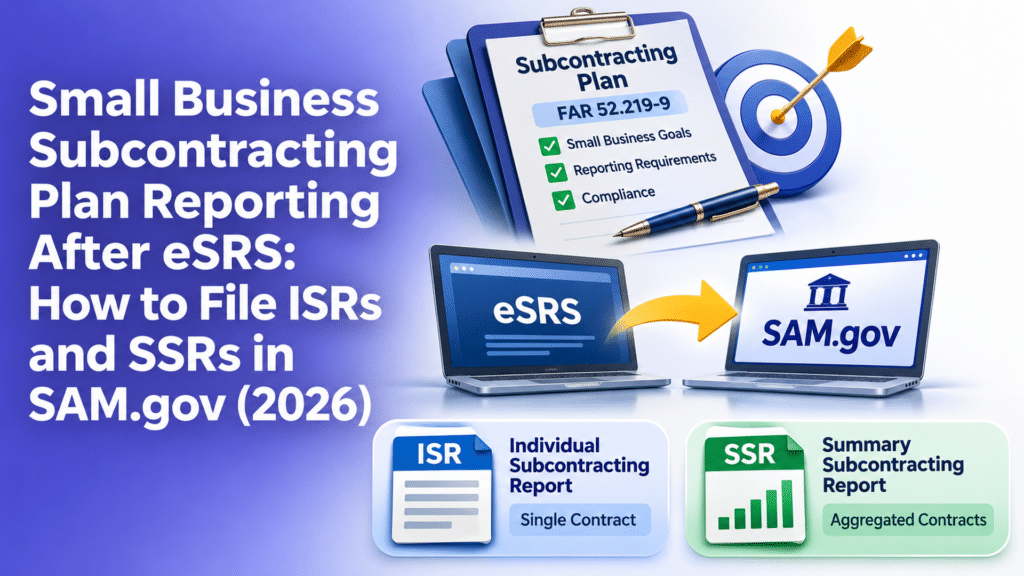
A small business subcontracting plan is a contract document, required by FAR 19.702 and FAR 52.219-9, in which a large prime contractor sets dollar and percentage goals for subcontracting with small businesses. Since eSRS.gov retired on February 20, 2026, primes file the Individual Subcontract Report (ISR) and Summary Subcontract Report (SSR) in SAM.gov.
Key Takeaways
- A small business subcontracting plan is required from other-than-small offerors on federal contracts above the FAR 19.702 threshold that have subcontracting possibilities.
- GSA decommissioned the Electronic Subcontracting Reporting System (eSRS.gov) on February 20, 2026, and moved subcontracting reporting into SAM.gov.
- The Individual Subcontract Report covers one contract for six-month periods ending March 31 and September 30.
- The Summary Subcontract Report rolls up a prime contractor’s subcontracting for the full government fiscal year ending September 30.
- SAM.gov controls report access by Unique Entity Identifier (UEI) and Procurement Instrument Identifier (PIID) and allows only one report per PIID.
- Accurate reports depend on clean accounts payable data, verified supplier size status, and consistent socioeconomic classifications.
What Is a Small Business Subcontracting Plan Under FAR 52.219-9?
A small business subcontracting plan is defined as the written commitment a prime contractor makes, under FAR 52.219-9, to give small, veteran-owned, service-disabled veteran-owned, HUBZone, small disadvantaged and women-owned small businesses subcontracting opportunities. It sets dollar goals and percentage goals, names a program administrator, and commits the prime to report actual results twice a year.
The plan becomes part of the contract, and agencies use reported results on the SBA Small Business Procurement Scorecard. According to the Office of Federal Procurement Policy (2024), federal prime contractors awarded a record $86.4 billion in small business subcontracts in FY 2023. According to the Office of Federal Procurement Policy (2024), almost $1.5 billion more in subcontract awards would have gone to small businesses in FY 2023 if primes had met the goals in their plans on completed contracts.
Who needs a small business subcontracting plan?
Under FAR 19.702, a plan is required when a negotiated or sealed-bid contract, or a modification, is expected to exceed the threshold and has subcontracting possibilities. The FAR text on Acquisition.gov lists $900,000, or $2 million for construction. Small business concerns are exempt. Thresholds adjust for inflation, so check your solicitation.
What must a small business subcontracting plan include?
Paragraph (d) of FAR 52.219-9 lists the required elements. The most important ones are:
- Separate goals, in dollars and as a percentage of total planned subcontracting, for each small business category.
- A description of the principal supplies and services to be subcontracted.
- The method used to develop the goals and to identify potential sources.
- Whether indirect costs are included in the goals and how they are allocated.
- The name and duties of the individual who administers the subcontracting program.
- Commitments on timely payment of small business subcontractors.
How the eSRS SAM.gov Transition Changed Small Business Subcontracting Plan Reporting
The eSRS SAM.gov transition moved every small business subcontracting plan report into one federal system. GSA announced that eSRS.gov would be decommissioned on February 20, 2026, and its reporting capabilities would move to SAM.gov, where prime contractors already maintain entity registrations.
The SAM.gov subcontracting reporting page explains the new access model. Reporting access is controlled by UEI and PIID, only one report is permitted per PIID, and prime contractors must have a Contract Action Report on file. NAICS and PSC codes are no longer required on the ISR or SSR.
| Item | eSRS.gov (before February 2026) | SAM.gov (2026 onward) |
|---|---|---|
| Access | Separate eSRS user accounts | Controlled by UEI and PIID |
| Reports per contract | Varied by setup | One report per PIID |
| NAICS and PSC on ISR/SSR | Entered on reports | No longer required |
| Prerequisite | Contract data from FPDS | Contract Action Report on file |
What changed for prime contractors in 2026?
The FAR Council also amended the FAR Part 19 model deviation text to align with the eSRS retirement as part of the FAR Overhaul. The FPDS public site moved into SAM.gov on February 24, 2026, so primes now see contract records and subcontract reports in one place.
How to File ISRs and SSRs for a Small Business Subcontracting Plan in SAM.gov
To file small business subcontracting plan reports in SAM.gov, the prime confirms its UEI and contract access, pulls subcontract award data for the period, validates supplier size and socioeconomic status, then submits the individual subcontract report for each contract and the summary subcontract report for the fiscal year. Follow these steps:
- Confirm your SAM.gov entity registration is active and the right users have subcontract reporting roles for your UEI.
- Verify that each contract with a plan has a Contract Action Report, so the PIID appears for reporting.
- Extract subcontract payments for the period from your ERP, such as SAP Ariba, Coupa or Oracle.
- Match each subcontractor to verified size and certification data, including 8(a), HUBZone, WOSB, VOSB and SDVOSB status.
- Calculate cumulative dollars and percentages against each plan goal.
- Submit the report, record the confirmation, and respond quickly if the contracting officer rejects it.
ISR vs. SSR: what is the difference between the two reports?
The difference between an individual subcontract report and a summary subcontract report is scope. Under FAR 52.219-9, the ISR shows cumulative subcontract dollars for one contract with an individual plan, while the SSR summarizes subcontracting across an agency’s contracts for the full fiscal year.
| Feature | Individual Subcontract Report (ISR) | Summary Subcontract Report (SSR) |
|---|---|---|
| Scope | One contract with an individual plan | All contracts for an agency, or the company for commercial plans |
| Frequency | Semi-annual | Annual |
| Reporting periods | Periods ending March 31 and September 30 | Government fiscal year ending September 30 |
| Commercial plans | Not required | Required |
Deadlines may shift. In a December 2024 proposed rule, SBA proposed extending subcontracting report due dates from 30 to 45 days, so confirm the current due date with your contracting officer each cycle.
What are common small business subcontracting plan reporting errors?
- Counting a supplier as small when its size status has expired or does not match the NAICS code assigned to the subcontract.
- Reporting only direct subcontracts when the plan’s goals include allocated indirect costs.
- Duplicate supplier records that split spend across two vendor IDs.
How Prime Contractors Pull Accurate Small Business Subcontracting Plan Data
Prime contractors pull accurate small business subcontracting plan data by treating the report as a data quality exercise, not a form. They connect accounts payable records to a verified supplier master, refresh size and certification status before each period, map spend to the right contract, and keep an audit trail for every dollar reported.
According to the Congressional Research Service (2026), small businesses have received 31% to 36% of federal subcontract award dollars every year since FY2019, roughly over $90 billion in FY2024. According to SmallGovCon (2025), agencies awarded $183.5 billion, or 28.76% of federal contracting dollars, to small business prime contractors in FY2024.
Where should subcontract reporting data come from?
Start with the ERP or AP system of record. Supplier records should carry UEI, size status, certification type, certifying body and expiration date. Our guide to why data quality is the biggest challenge in supplier diversity reporting explains how duplicate and outdated records distort results.
Many primes also collect spend from their own suppliers to show indirect impact, a process covered in our practical guide to Tier 1 vs. Tier 2 suppliers.
Illustrative example: one contract, one reporting cycle
In this illustrative example, a prime holds a $40 million federal services contract whose plan commits 30% of $10 million in planned subcontracts to small businesses, or $3 million. By September 30, it has paid $4.2 million in subcontracts, $1.1 million to verified small businesses. Its ISR shows 26.2% against the 30% goal, which flags a gap the program administrator can address before the next cycle.
In one STARS case study, a global rental car company unified multiple AP systems into a single, automated reporting platform that improved efficiency, compliance and supplier diversity visibility.
How STARS Supports Small Business Subcontracting Plan Compliance
STARS supports small business subcontracting plan compliance by giving prime contractors one place to monitor contract spend, verify payments and collect supplier data. Its Contract Spend Compliance module tracks spend against contract commitments in real time, while Tier 2 Spend Reporting automates data collection from suppliers through a validated portal.
STARS Contract Spend Compliance includes a centralized contract repository, real-time monitoring, automated alerts for compliance, overspend and renewal deadlines, a payments and spend verification module, customizable reporting and ERP integration. These help teams catch goal shortfalls before an ISR is due. See our post on contract compliance tracking dashboards.
STARS Tier 2 Spend Reporting gives suppliers a user-friendly portal to submit spend data, validated for accuracy, with automated reminders. STARS reports 35% more reportable diverse spend by automating Tier 2 collection and an 80% reduction in follow-up burden. STARS prepares the data; your team still files the ISR and SSR in SAM.gov.
Regulatory details in this article reflect public sources as of November 2026. Confirm specifics for your contracts with counsel or your compliance advisor.
Conclusion: Building a Reliable Small Business Subcontracting Plan Reporting Process
A small business subcontracting plan is only as strong as the data behind it. First, know what FAR 52.219-9 requires. Second, adapt to SAM.gov, where access runs on UEI and PIID after the eSRS retirement. Third, build clean, verified supplier data so every ISR and SSR is accurate and defensible. Primes that automate these steps spend less time chasing numbers and more time developing small suppliers.
Ready to make subcontract reporting easier? Contact STARS to see how Contract Spend Compliance and Tier 2 Spend Reporting can support your next reporting cycle.
Help Center
Frequently Asked Questions About Small Business Subcontracting Plan Reporting


Marketing professional passionate about people, creativity, and meaningful growth. Proud to be part of the STARS team, empowering businesses to discover and manage diverse suppliers through one powerful platform.